
If you traveled anywhere to kick off America’s 250th anniversary year, it may have been to the nation’s capital in Washington D.C. or its birthplace in Philadelphia. But we can’t forget that our own Old Line State also made significant contributions to America’s founding.
The critical roles that Baltimoreans—particularly women, African Americans, immigrants, exiles, indentured servants, and foreign allies—played in the revolution are detailed in the magazine’s July cover story, here. And Annapolis, our charming state capital, is a pillar of American history in its own right.
Here’s an overview: In colonial days, the town thrived as a prosperous political, cultural, and commercial hub, ushering in a class of wealthy merchants. Georgian architecture and a rich maritime culture made the area a major destination for travelers. However, the city’s “Golden Age” ended with the Revolutionary War, when Annapolis transitioned into an integral military center and supply depot.
From 1783 to 1784, Congress convened at the Maryland State House, making Annapolis America’s first peacetime capital. The oldest continually used state capitol in the country, it was here that George Washington notably resigned his military commission in December 1783—a historic moment that set the precedent for the nation’s values. Only a month later, the Treaty of Paris was ratified by Congress, officially ending the Revolutionary War. Annapolis remained the nation’s capital until August 1784, when Congress relocated to Trenton, New Jersey.
With the semiquincentennial on everyone’s minds, we put together an itinerary for immersing yourself in the nation’s history while strolling our scenic state capital—from liberty landmarks to enlightening exhibits.
Museum of Historic Annapolis
99 Main St. 10 a.m.-5 p.m. daily. $7.
Kick off your day by wandering through the museum’s three floors. Beginning in 1650 with the founding of Anne Arundel County and continuing to the city at present day, the permanent display chronicles the story of America’s first peacetime capital with interactive elements, historic artifacts, and enlightening photographs. Each room offers a glimpse of Annapolis over 400 years, from the Indigenous peoples that inhabited the area, to the “Golden Age” before the American revolution, to the realities of the Civil War and the Jim Crow era of segregation.
You’ll learn about Maryland’s four signers of the Declaration of Independence (more on them below), Annapolis’s maritime culture, and so much more, making it the perfect gateway to other historical sites in the city. And be sure to stop by the community gallery on the first floor, where the museum presents The Power of One, honoring 17 lesser-known Annapolitan trailblazers throughout the nation’s 250-year history.
Site of the Annapolis Liberty Tree
St. Johns College, 60 College Ave. Marker on the lawn near McDowell Hall. Free.
Long before it was a revolutionary landmark, this tulip poplar was just a tree on what would become the St. Johns College Campus. As one of dozens of Liberty Trees across the colonies that served as town squares for public meetings and protest, the Sons of Liberty gathered beneath it in 1765 to protest the Stamp Act. Annapolis’s tree stood for more than two centuries, growing into one of the largest tulip poplars in the country before Hurricane Floyd took it down in 1999. A new poplar was planted on the site in 2007, and a marker on the lawn near McDowell Hall now shows exactly where the original stood.
The St. John’s poplar isn’t the only Liberty Tree in town. A genetically identical descendent of the original was planted on Maryland Day 2026 in front of the William Paca House and Garden on Prince George Street. The second tree was added as part of a statewide project putting the symbolic Maryland Liberty Trees in every county ahead of the 250th.
Homes of the Maryland Signers
Maryland sent four men to sign the Declaration of Independence, and all four of their Annapolis homes still stand today, within easy walking distance of one another. Fun fact: Annapolis is the only city in the country where the homes of every one of its state’s signers remain in tact.
- William Paca House and Garden: William Paca was the state’s third Governor, and his home is recognized as a National Historic Landmark due to its fine Georgian-style infrastructure—featuring a restored two-acre pleasure garden behind the house, and the newly planted 2026 Liberty Tree out front. 186 Prince George St. Regularly open to the public
- Charles Carroll House and Garden: Charles Carroll of Carrollton was the only Catholic to sign the Declaration, which helped secure religious freedom for all citizens at the time. 107 Duke of Gloucester St. Open to the public via tours on the first two weekends of the month from June-Nov.
- Chase-Lloyd House: Samuel Chase is the only Supreme Court justice to have been impeached, which helped establish the Supreme Court as a completely separate branch of government. Through a community grant, the Chase Home is now dedicated to supporting women facing housing insecurity. 22 Maryland Ave. Gardens are open to the public.
- Peggy Stewart House: Once owned by lawyer and state senator Thomas Stone, the 18th-century mansion is marked as a National Historic Residence. However, it’s now privately owned, so visitors can admire it from the sidewalk near the entrance of the Naval Academy. 207 Hanover St.
Old Fox Books and Coffeehouse
35 Maryland Ave. 8 a.m.- 5 p.m. daily.
By lunchtime, you’ll be ready to take a load off. Fuel up with eats, drinks, and browsing at Old Fox Books, which has its own quiet piece of American history integrated within it. Long before it was lined with bookshelves, the building operated as a greengrocer from the 1880s through the 1920s. It was run by a Naval Yard chef and his Irish wife.
When they opened the shop 10 years ago, co-owners Ginny Amundson and Janice Holmes named it after George Washington—who walked this very street up to the State House and was nicknamed “The Old Fox” by British Lieutenant General Charles Cornwallis during the Revolutionary War. (It’s also fitting that Maryland Avenue sits between King George and Prince George streets.) The name has prompted regulars to show up with fox figurines and gifts, which the owners happily accept for their collection that now includes more than 45.
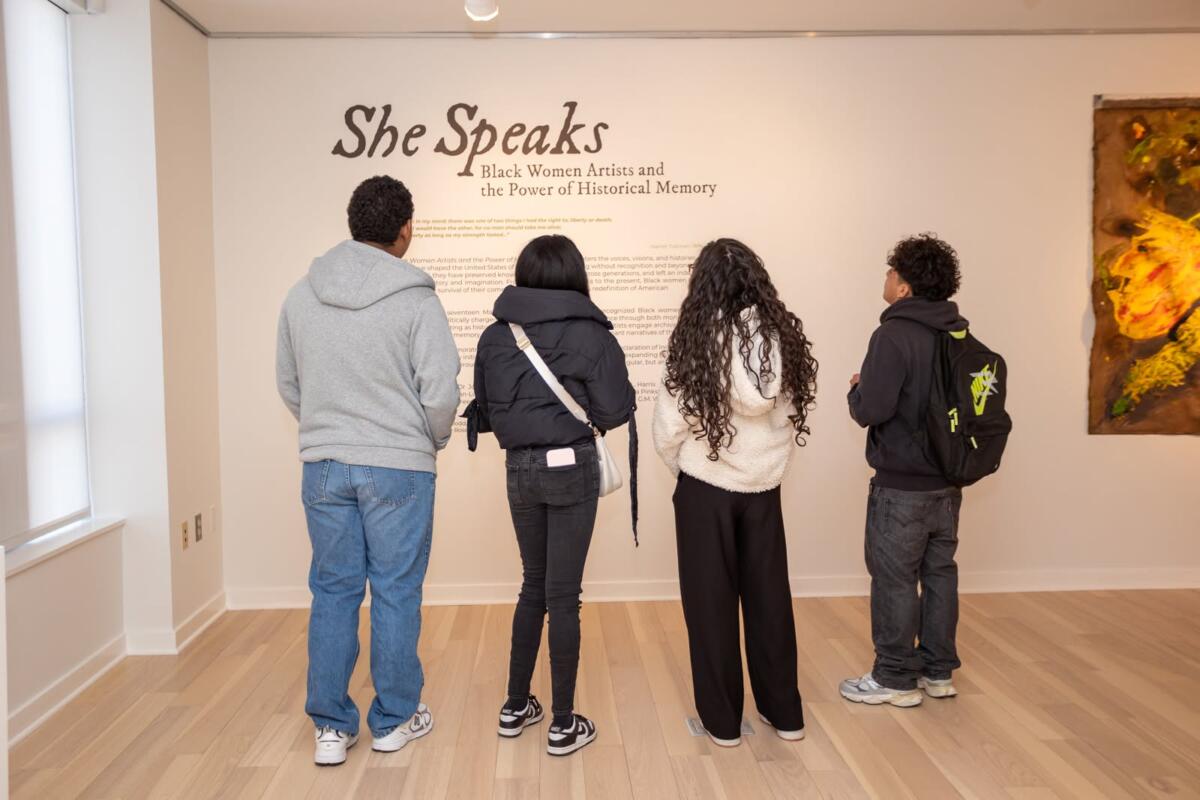
She Speaks: Black Women Artists and the Power of Historical Memory at the Banneker-Douglass-Tubman Museum
84 Franklin St. Tues.-Sat., 10 a.m.-4 p.m. Free.
Featuring works by 17 Black women artists–11 of whom have roots in the DMV–the Banneker-Douglass-Tubman Museum’s newest exhibit (on view through January 2027) seeks to challenge dominant narratives about American history by presenting the nation’s past through a Black feminist lens. Housed in the former Mount Moriah AME Church built in 1874 by free African Americans, the museum itself is also a piece of Annapolis history.
Curator Martina Dodd says she and executive director Chanel C. Johnson were inspired to mount She Speaks after recognizing the gaps in national and local efforts surrounding America 250. “We started to notice a trend that oftentimes the Black artists, Black scholars, or even just Black contributions were not being included in these conversations,” Dodd says.
The exhibit corrects that by amplifying Black creativity and memory, highlighting everything from paintings and sculptures to installations and films. In their works, the artists examine personal and family history, question official records, and imagine new futures.
Many of the pieces use archival materials, like Darlene Taylor’s mixed-media works using preserved fabrics. Other loaned heirlooms include Cambridge civil rights activist Gloria Richardson’s childhood christening gown, highlighting the legacies physical objects hold. A film by Baltimore-based artist Ada Pinkston documents a performance from her series Landmarked, in which she reimagines the spaces left behind from removed confederate memorials.
Walking through the exhibit illuminates the power of art to teach and inform.
“It can be a way to spark social change,” Dodd says. “It can be a way to heal and to look into new possibilities of what the next 250 years could look like if we are reconsidering the histories that we’ve always learned.”