Sports
The 1966 Trade for Frank Robinson Turned the O’s Into a Dynasty—and Changed Baltimore
During the veteran slugger's playing career in Baltimore, the Orioles were the best team in professional sports, and maybe the best baseball club ever.
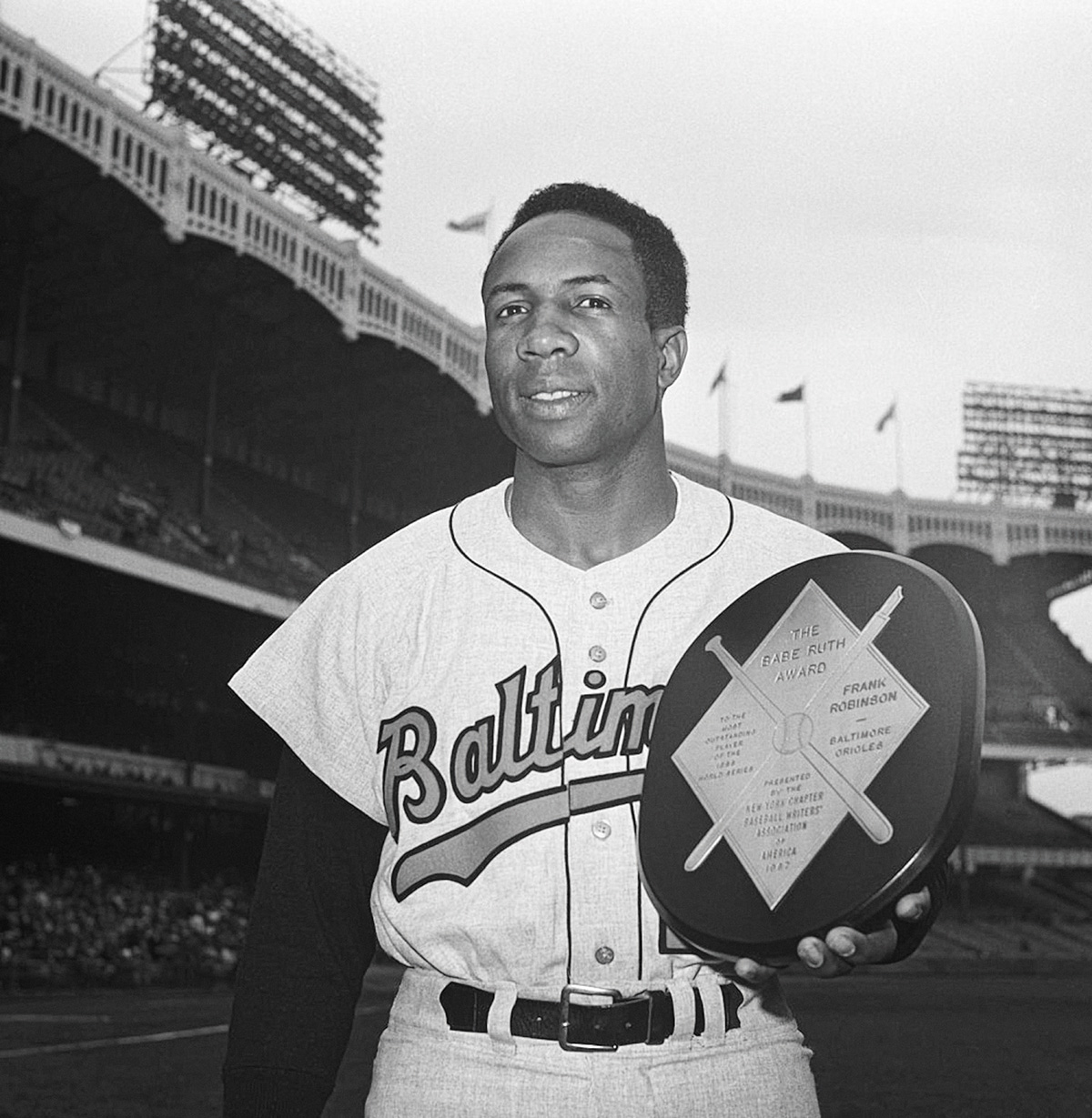
Fifteen-year-old Mike Sparaco and his buddy, Bill Wheatley, had made plans to meet two girls for miniature golf on Sunday, May 8, 1966. Instead, they got stood up. Not a great feeling, but it happens. On the teenagers’ dejected walk home, however, a greater fate—there is no other word for it—intervened.
While cutting through the parking lot at Memorial Stadium, a roar erupted, causing them both to glance up. Suddenly, fans in the top row of the bleachers began yelling and gesturing toward them.
“We thought, ‘What’s going on?’” Sparaco recalled in a 2016 interview with The Sun. “Bill said, ‘Maybe somebody hit one out.’ I said, ‘Great, maybe we’ll get a new baseball and play with it.’”
The first car he peaked under was a white Cadillac and there was the ball, almost but not quite in reach. “No sooner had I crawled under to get it than all these people came running over. A guy with a transistor radio shouted, ‘Frank Robinson just hit that!’”
Robinson’s blast, off Cleveland’s Louis Tiant, who had tossed three straight shutouts to start the season, was like a scene from The Natural. Departing Memorial Stadium high above the leftfield line, the tiny sphere cleared the Colts’ press box before bouncing over a fence and rolling to a stop 540 feet from home plate.
The Orioles needed to sweep that day’s twin bill to vault into a first-place tie with Cleveland. Buoyed by 11,000 youngsters on hand for Safety Patrol Day, a record crowd of 49,516 watched the O’s take the opener, 8-2, behind Robinson’s first home run of the day.
Paced by his epic first-inning salvo off Tiant, they won again, 8-3, in the second contest. The feat so inspired the city that the team’s booster club, the Orioles Advocates, commemorated it. During a pregame ceremony a week later, they raised an orange flag with black lettering at the spot where the ball exited the park. It simply read “HERE” and flew until the O’s final season on 33rd Street.
More importantly, the moonshot put the American League—and Baltimore, then a Colts town—on notice that the O’s, known for their pitching and defense, were now a potent offensive force as well.
The O’s had acquired the veteran slugger in the offseason from Cincinnati, where Reds’ owner Bill DeWitt described Robinson as “not a young 30” after the deal. The words haunted DeWitt, who would sell the team at year’s end, and lit a fire in Robinson. He smashed a home run in each of his first three games in his new uniform. Still, this one was different.
As Robinson jogged to right field to start the next inning, public-address man Bill LeFevre announced the HR was the first ever hit completely out of Memorial Stadium. During a nearly minute-long standing ovation, Robinson tipped his cap several times.
The moment went beyond baseball. Not only had he spent a decade in Cincinnati before being told to pack his bags, he and his wife, Barbara, had confronted prejudice in buying a house in Baltimore, their adopted, racially diverse, but segregated city.
On the 50th anniversary of the mythic blast, Robinson called the ovation a seminal moment in his career. Hearing the cheering, the slugger told The Sun, “I felt like I really belonged in Baltimore.”
Jackie Robinson was venerated for the abuse he silently withstood while breaking baseball’s color line. Frank Robinson, whose rookie year overlapped Jackie Robinson’s last season, was not a turn-the-other-cheek ballplayer.
“Bad trades are part of baseball—now who can forget Frank Robinson for Milt Pappas, for God’s sake?”—Annie Savoy (Susan Sarandon’s character) in Bull Durham.
In early December 1965, when baseball news typically sprinkled the sports section like light snow, the Orioles and Reds announced a swap that would rank among the most consequential in the history of professional sports. So much so that, like Boston’s short-sighted sale of a certain larger-than-life Pigtown native to the Yankees, it became a part of baseball lore.
In Cincinnati, DeWitt framed it as forward-looking. Milt Pappas had won 16 games in ’63 and ’64 for the O’s. He was 26 and the team’s all-time winningest pitcher. The Orioles threw in Jack Baldschun, a solid reliever, and untested outfielder Dick Simpson. Suffice to say, none played up to the Reds’ hopes.
Robinson belonged in another class altogether. With guys named Mays, Mantle, Aaron, and Clemente. He had won Rookie-of-the-Year honors, an MVP trophy, and carried Cincinnati to the ’61 pennant. The year prior to the trade, in an era dominated by pitching, he mashed 33 homers and drove in 113 runs. DeWitt, however, a devotee of former Brooklyn Dodger GM Branch Rickey, believed “it was better to trade a player a year early than a year late.” He also maintained his club needed pitching, which was true. Left unmentioned was DeWitt’s contentious relationship with his star.
In Baltimore, the reaction was jubilation.
“Cannons at the four corners!” Harry Dalton, the O’s director of player personnel, shouted upon completing the deal, referring to the power-packed foursome of first baseman Boog Powell, third baseman Brooks Robinson, left fielder Curt Blefary, and the new slugger in right.
Considered one of the sharpest baseball executives ever, Dalton understood how Robinson would impact the O’s lineup. Batting behind him, Brooks and Boog drove in 209 runs. Behind them, Blefary added 23 home runs and another 64 RBIs. Frank? He won the Triple Crown (.316, 49 HRs, 122 RBI) and the MVP—the only player to win the award in both leagues until Shohei Ohtani accomplished the feat in 2024.
The Orioles took the pennant by a landslide nine games. Then, in one of the most dominating World Series performances ever, the O’s swept the favored Los Angeles Dodgers. Robinson drilled a first-inning HR in the opener out west. Then another in the series-clincher here.
“Sometimes, you can point to one incident in a season as a big one,” veteran O’s reliever Moe Drabowsky recalled to longtime Sun sportswriter John Eisenberg. “To me, when Frank hit that ball out of the stadium off Tiant, it galvanized the whole team. It was like, ‘We’re going to be tough to beat this year.’”
Jackie Robinson was venerated for the abuse he silently withstood while breaking baseball’s color line. Frank Robinson, whose rookie year overlapped Jackie Robinson’s last season, was not a turn-the-other-cheek ballplayer. He leaned over home plate and defied pitchers to throw inside. Hit 198 times in his career, he gained a reputation for dusting himself off and getting his revenge with a retaliatory home run. (Don Drysdale, who Robinson homered off in his first at bat of the ’66 Series, was a familiar nemesis.)
Even at 51 in an old-timers’ game, after being accidentally knocked down by former big-league pitcher Jim Bibby, Robinson dug back in and put one over the fence. Similarly, Robinson was a menace on the basepaths, breaking up double plays like a linebacker. Early in his career, a hard, spikes-up slide into third base led to a scrap with Braves’ Hall of Famer Eddie Matthews, who blackened his eye with a right cross. Robinson had to leave the field, but, true to form, returned for the second game of the doubleheader and responded with a home run and decisive catch.
He had played in segregated environments in Utah and South Carolina in the minor leagues, places where he wasn’t allowed to eat in the same restaurants or stay in the same hotels as his white teammates. Those experiences and others may have hardened his exterior as a young ballplayer.
But, raised in hardscrabble Oakland, California, he was never a go-along-to-get-along type. Neither, coincidentally, were two guys he played ball with growing up—Bill Russell, who became the first Black head coach in the NBA in 1966—and Curt Flood, the Black centerfielder who challenged baseball’s reserve clause and set the stage for free agency in the 1970s.
Robinson, of course, would become baseball’s first Black manager with Cleveland in 1975—and win AL manager of the year honors for helming the O’s 1989 “Why Not?” run. One thing Robinson let his new teammates know was that he didn’t believe in fraternizing with the enemy. The O’s were a little too congenial for his liking.
“If somebody was talking on the field with one of the opposing players, Frank would say, ‘Why do you go out and talk to those guys when in five minutes, you’re going want to kick their butt?’” Powell says. “‘Take them out for dinner after the game. They’re not your friends on the field.’ And he was right and we stuck to that.”
Robinson, who did not lack for a sense of humor despite his fierceness between the lines, also instituted and served as the presiding judge of the team’s Kangaroo Court. With a mop over his head and a broom handle as his gavel, Robinson dispensed fines for mental errors and botched routine plays.
“We only did it after games we won so there’d be no hard feelings. If you threw to the wrong base, it cost you a dollar,” Powell says. “It wasn’t the dollar. It was that someone was paying attention [to your mistake] and you knew it. That was the edge Frank brought to the team.”
“What did Frank mean to the Baltimore Orioles franchise?” Jim Palmer mused, phoning into a MASN show shortly after his ex-teammate passed in 2019. “He put us on the map.”
In fact, Drabowsky’s prediction that the O’s would be “tough to beat” in ’66 after Robinson’s parking lot shot proved an understatement. During Frank Robinson’s playing career in Baltimore, the O’s were the best team in pro sports and maybe the best baseball club ever.
From 1966 to 1971, they won 100 games three times, captured four pennants, and took a second World Series in 1970. (Not incidentally, Drabowsky, who tossed 6-plus innings of scoreless relief in Game 1 of the ’66 Series, played a significant role on several of those clubs.)
To be clear, the Orioles were a very good baseball team before Robinson came over. They finished third in the 10 team AL in ’64 and ’65. And they didn’t just have “cannons at the corners” in ’66. They had Hall of Famers at third in Brooks and at short in Luis Aparicio. And future All-Stars Paul Blair and Davey Johnson stepping into full-time roles in center and at second.
The O’s themselves weren’t sure they needed Frank Robinson. A fourth future Hall of Famer, 20-year-old Jim Palmer, was set to join 23-year-old standout Dave McNally in the rotation.
“When the trade was announced, I was sorry to see Milt go,” Powell recalls from Florida as the 2026 preseason gets underway. “He was a friend, teammate, and a genuinely good pitcher.”
Indeed, Pappas finished with 209 career victories. “I respected Frank, we all did,” Powell says. “But we didn’t know Frank.”
The devotion the team receives today can be traced back to the heyday of Frank and Brooks and that first, unlikely championship 60 years ago.
Robinson had carried a rep in Cincinnati as a difficult guy. That changed quickly. As far as his new teammates were concerned, it was love at first sight. Robinson later commented the city might not have been ready for him, a reference to the housing bias, “but the Orioles were.”
“The day he arrived at spring training, he hit one after another into the palm trees,” Powell says. “I still remember telling Etch [catcher Andy Etchebarren], standing next to me, ‘We’ve taken a step up.’ Frank fit in right from the start. We liked the way he was and didn’t want him to be anyone other than who he was.”
Robinson’s issues with the Reds management stemmed from racial prejudice, salary disputes, and his outspoken personality. Pete Rose later said the club gave him grief for becoming too friendly with Robinson and Vada Pinson, another Black ballplayer. When fans and the Cincinnati media gave Robinson a hard time during the ’65 slump, it convinced DeWitt he could move him without too much blowback.
Meanwhile, Baltimore Afro-American Hall of Fame baseball writer Sam Lacy, civil rights groups, and Black fans had pushed the O’s for years to sign Black players. For their part, the Orioles acknowledged they hoped Robinson would appeal to the city’s “Negro” community.
The team’s leader when he arrived was the guy whose last name he shared. Brooks Robinson’s soft-spoken modesty and civility endeared him to everyone—never more so than when Frank Robinson joined the club.
A six-time All-Star, Brooks had earned his own MVP in 1964. The addition of another superstar, a Black slugger who’d been labeled “a troublemaker” by his previous club, could’ve potentially disrupted the team’s chemistry. But while Frank dealt with remnants of legal segregation in Baltimore, his acceptance in the O’s clubhouse was a non issue. (On the cusp of the World Series, Mayor Theodore McKeldin appealed to bar owners to ignore state law allowing them to ban Black residents: “I find it a distasteful piece of irony that I must make this plea in light of the fact that without Frank Robinson, a person who could be excluded by such business, we would probably have no World Series.”)
In his 1988 autobiography, Extra Innings, Frank said race relations on those Orioles teams were unlike any other club he played for. Brooks and Frank dressed next to each other for the entirety of their six years together in Baltimore, setting the tone for the team. The pair became known as the “Robinson Brothers” and after their playing careers, made a Lite Beer commercial playing off their names and similarities, clarifying, however, “we are not identical twins.”
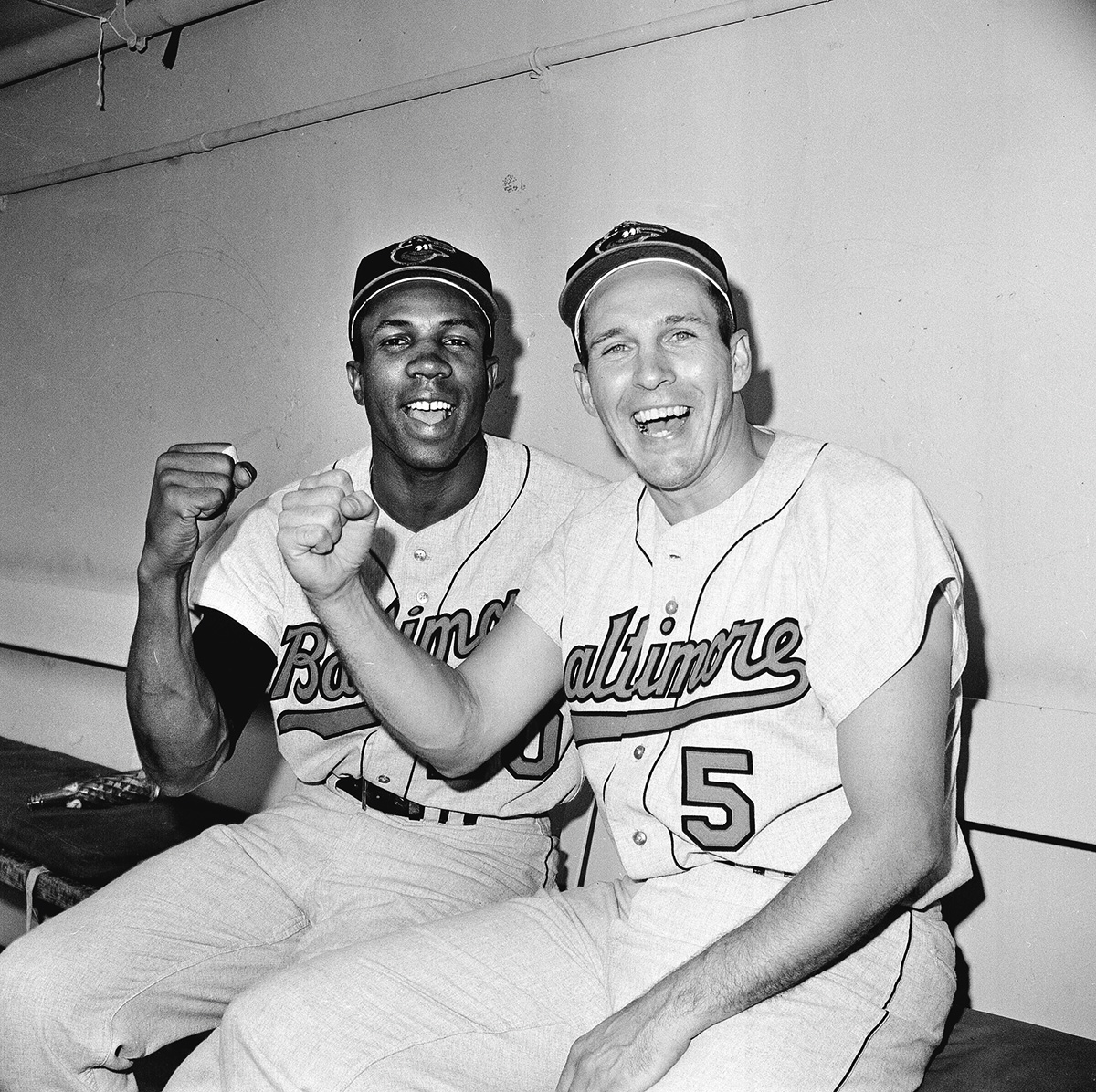
The images of Brooks and Frank—one from Little Rock, Arkansas, the site of pitched segregation battles, the other from the birthplace of the Black Panthers—standing shoulder to shoulder, hitting in tandem in the heart of O’s batting order spoke volumes during the Civil Rights era.
“I suspect Brooks was the key reason why, for the first time in my 14 years of professional baseball, Black players and white players had drinks together and meals together when we were on the road,” he wrote. “Not every single night, but two or three times on most road trips. None of the players really invited me, Paul Blair, or Sam Bowens to join them. But Brooks might ask me where I was going after a game, and not knowing the restaurants in most American cities, I might say I wasn’t sure. Then Brooks would say something like, ‘Well, Boog, Jerry [Adair], Curt, and I are going over to this restaurant.’”
Winning helps, and Orioles fans responded in kind, embracing the club as never before. The devotion the team receives today can be traced back to the heyday of Frank and Brooks and that first, unlikely championship 60 years ago.
Jim Melonas, whose son, Mark, raised a replica HERE flag at the old Memorial Stadium site—now a recreational field—on the 50th anniversary of Robinson’s home run, grew up in Hamilton. He had started his freshman year at the University of Maryland when the O’s met the Dodgers. He and his friends squeezed into a VW Beetle to greet the team at then-Friendship Airport after they won the first two games in L.A. Then they followed the team to Memorial Stadium.
“Somehow, we got stuck between two of their buses, and were waved into the team parking lot,” Melonas, who went on to a career in business, enthusiastically recalls. “We ended up helping carry some of the players’ bags. It was one of the best moments of my life.”
Though there was an encore. Days later, a girlfriend invited him to Game Four. Her father had an extra ticket. “Frank Robinson’s home run sailed two rows over our heads in left field.”
“Do I remember Frank Robinson coming to Baltimore?” asks Rev. Alvin Hathaway, who grew up with Elijah Cummings in West Baltimore and recently led the restoration of Thurgood Marshall’s elementary school. “I was at City College High School from 1966 to 1969. Those were the Orioles’ hottest years. I worked at Memorial Stadium part-time. Not only do I remember Frank Robinson, I was selling popcorn when Louis Tiant threw that ball that he knocked out of the park.”
Hathaway highlights how accessible Robinson was, as well as the city’s other pro athletes. “You’d see him and his wife, Barbara, at Cross Keys, around town. They were a regal couple. That era of sports figures were community-minded people. He embodied it.”
Hathaway also notes Baltimore was a Colts’ town prior to ’66 in the city’s white—and Black communities. For good reason. “They won championships, and had personalities like Lenny Moore, Jim Parker, Willie Richardson, John Mackey, Lenny Lyles. When Frank came in, this was a homerun guy, and you coupled him with Paul Blair, and things started to shift in terms of African Americans being attentive to the team.”
Academics were important at City College, but so were sports, Hathaway continues, adding he worked 15 to 20 ballgames at Memorial Stadium a year. He carried popcorn because it was light.
“I wanted to see the game,” he says. “I was on left field side when Frank stepped in against Tiant, who came up with that big windup. It was tense already when he threw that pitch, and man, and the next thing, all you heard was ‘pop!’ Everybody turned their head. I dropped my tray. I couldn’t believe how hard he had hit that ball. I still can’t.”