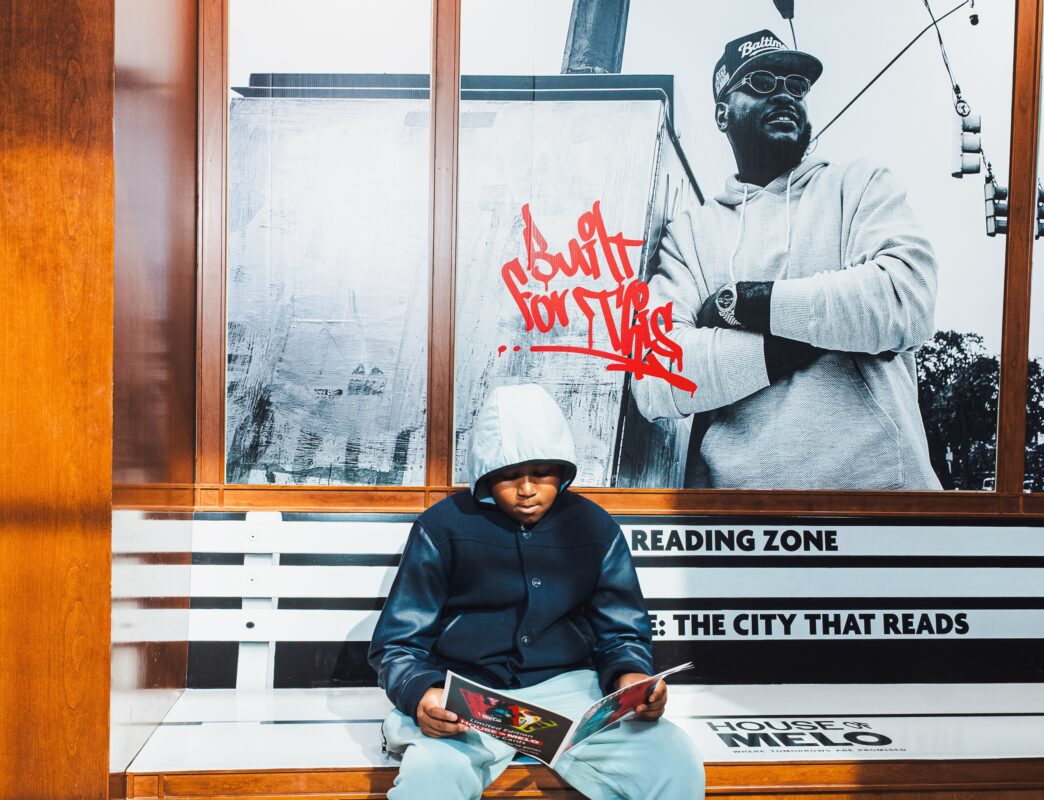
On Friday night, Baltimore basketball icon Carmelo Anthony stood tall, as he does, holding a microphone before hundreds gathered at the Enoch Pratt Central Library for the opening of House of Melo.
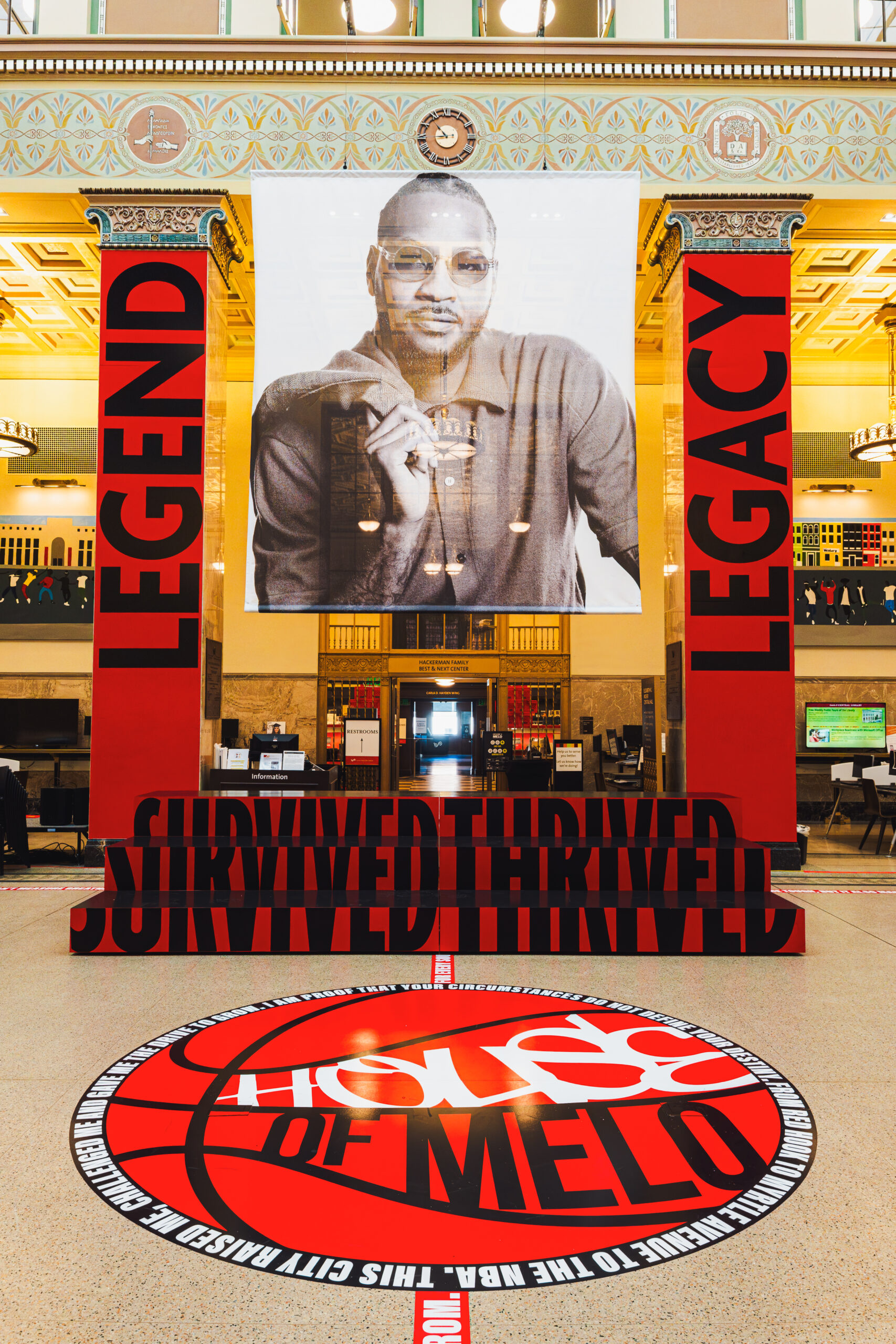
On view through December, the landmark exhibit celebrating Anthony’s life—which coincides with his 2025 induction into the Naismith Basketball Hall of Fame—has completely transformed the historic building’s first floor. A giant likeness of Anthony hangs from the library’s iconic main hall ceiling. Items telling his story dot the rooms around. He beamed seeing it all come together.
“This is special. I wanted to bring this here, and I’m very grateful,” Anthony said at the grand opening gala Friday. “After the year I’ve had, to be able to add taking over a library to my resume means a lot,” he continued, mentioning his Hall of Fame induction last month and developing business ventures following a 22-season and 10-time All-Star NBA career.
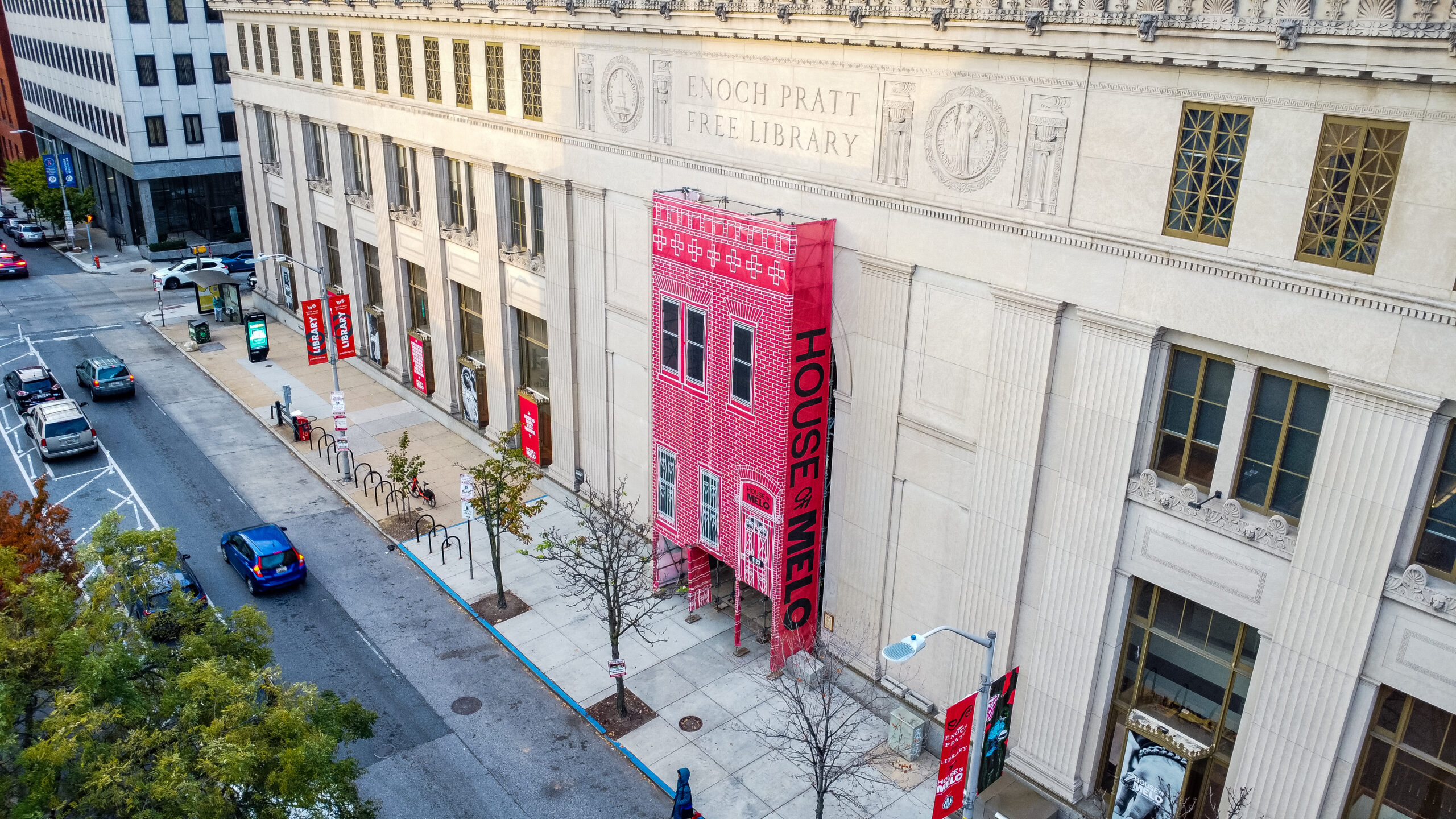
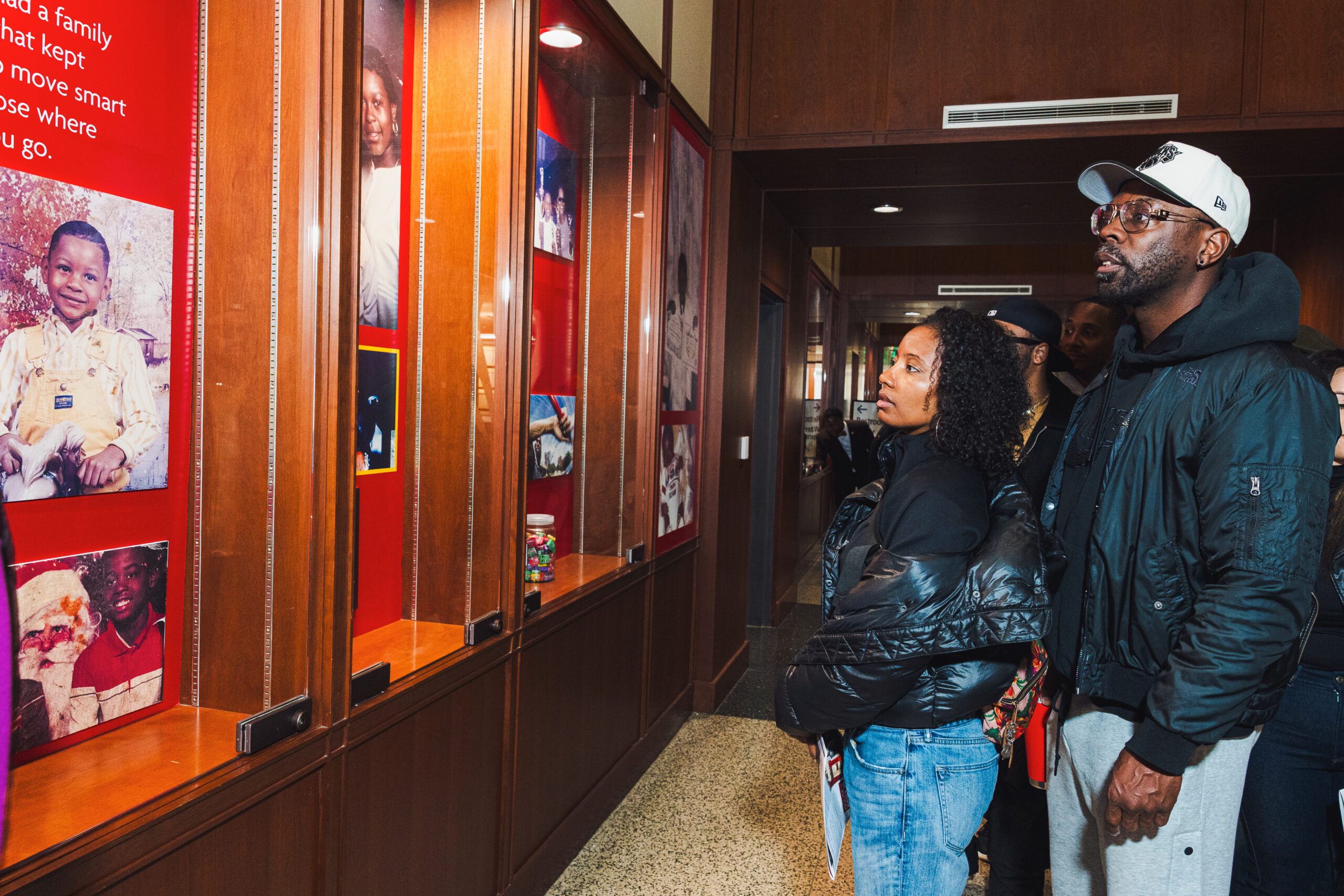
It is, indeed, a takeover. From the Cathedral Street entrance, now cased in red—the color of the rowhome on the 1100 block of Myrtle Avenue where Anthony lived from age 8 to his junior year of high school (at Towson Catholic)—to subtle yet powerful features like classic magazine covers; Anthony’s favorite music; milkcrate hoops; and NBA, Olympics, and Syracuse memorabilia that fit naturally amid the bookstacks, hallways, and rooms, it’s a fully immersive experience.
“It is a library. It ain’t like it’s a lounge, it ain’t like it’s a club,” Anthony said Friday night. “We still got to be respectful and responsible with what we’re doing and the messages that we’re putting out there.”
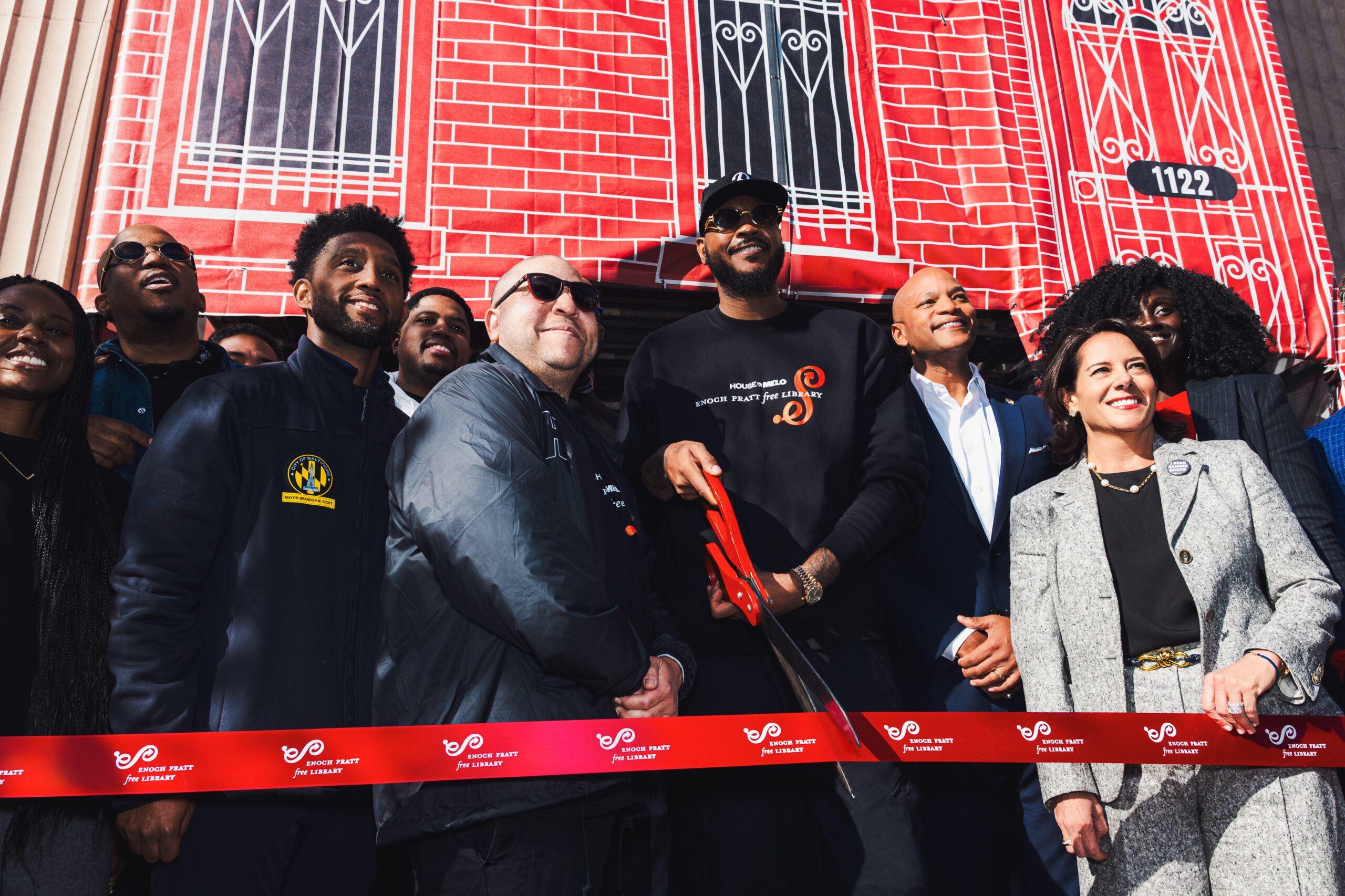
He formally opened the exhibit with a ribbon-cutting ceremony, attended by notables like Gov. Wes Moore and Mayor Brandon Scott, on Saturday morning. Baltimore writer D. Watkins, co-author of Anthony’s 2021 memoir, Where Tomorrows Aren’t Promised, and Khalilah Beavers, Anthony’s stylist and creative director of nearly 20 years, produced and designed the exhibit. Art from Baltimore’s Devin Allen is also featured throughout.
The idea, Anthony said, is to attract a new generation to the building, who might be inspired by a West Baltimore kid’s gritty coming-of-age story and accomplishments. The tagline is a spin on his memoir’s title: Where tomorrows are promised.
“We hope everyone will come from all over to view this,” Enoch Pratt Free Library CEO Chad Helton summed up.
To that end, here are a few highlights that you can’t miss when you visit. House of Melo is free and open to the public during regular Central Library hours: Monday-Thursday from 10 a.m. to 8 p.m., as well as Friday and Saturday from 10 a.m. to 5 p.m.
Home Court
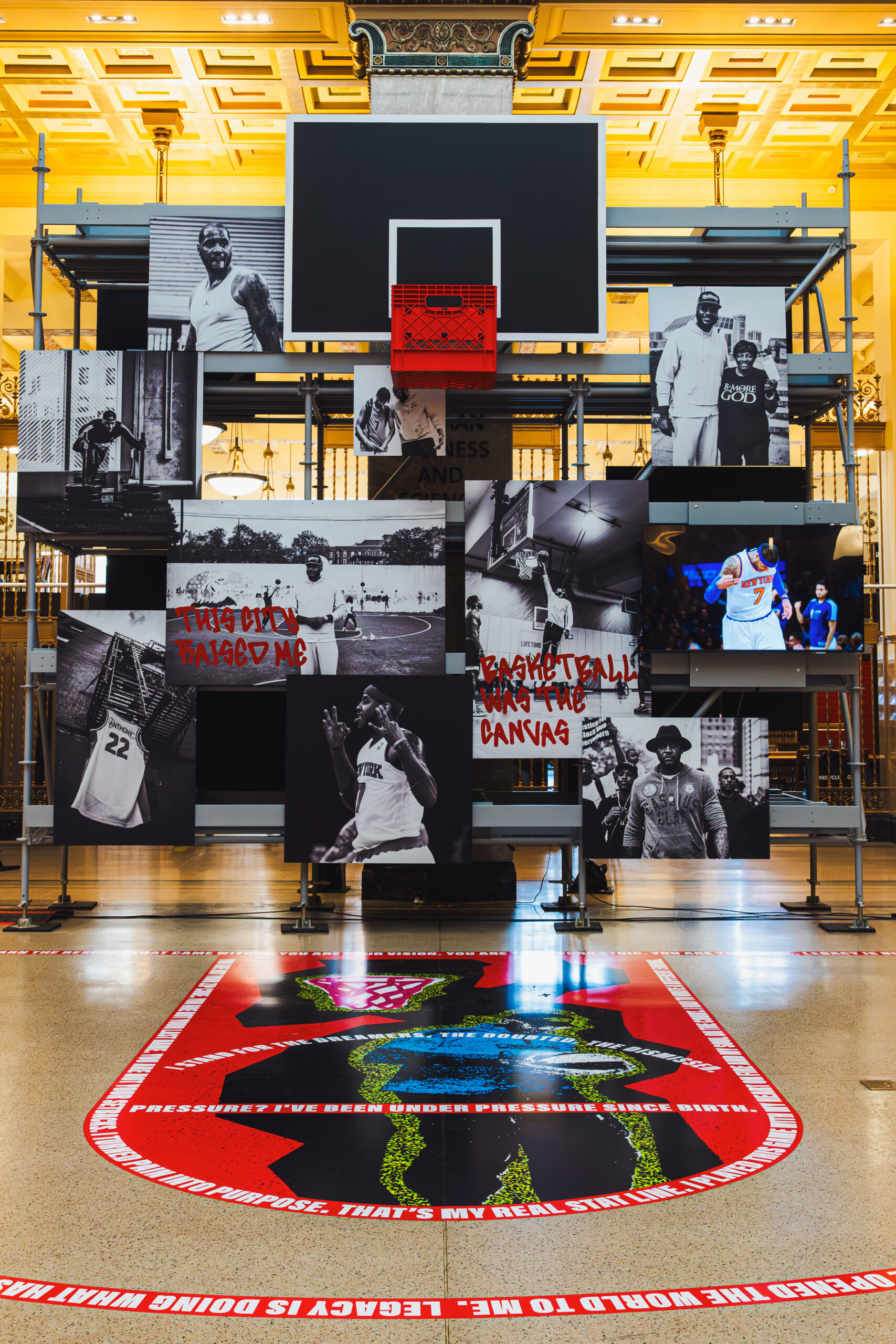
When you enter the library’s main hall, you’ll see a basketball court outlined on the floor, featuring Anthony’s own words in the design. “For every soul still trapped in the places I broke free from,” is quoted at the midline. “Pressure? I’ve been under pressure since birth,” marks the free throw line in front of a giant hoop at one end. It’s Anthony’s favorite part of the exhibit.
Before you go too far, though, don’t miss the QR code near the front desk to hear opening narration from Anthony, then Watkins, as they guide you through the House of Melo. “You’re not walking into a museum,” Watkins explains near the beginning, “you’re stepping inside of Melo’s story, a Baltimore story.” Keep your headphones on.
Soundtrack of Life
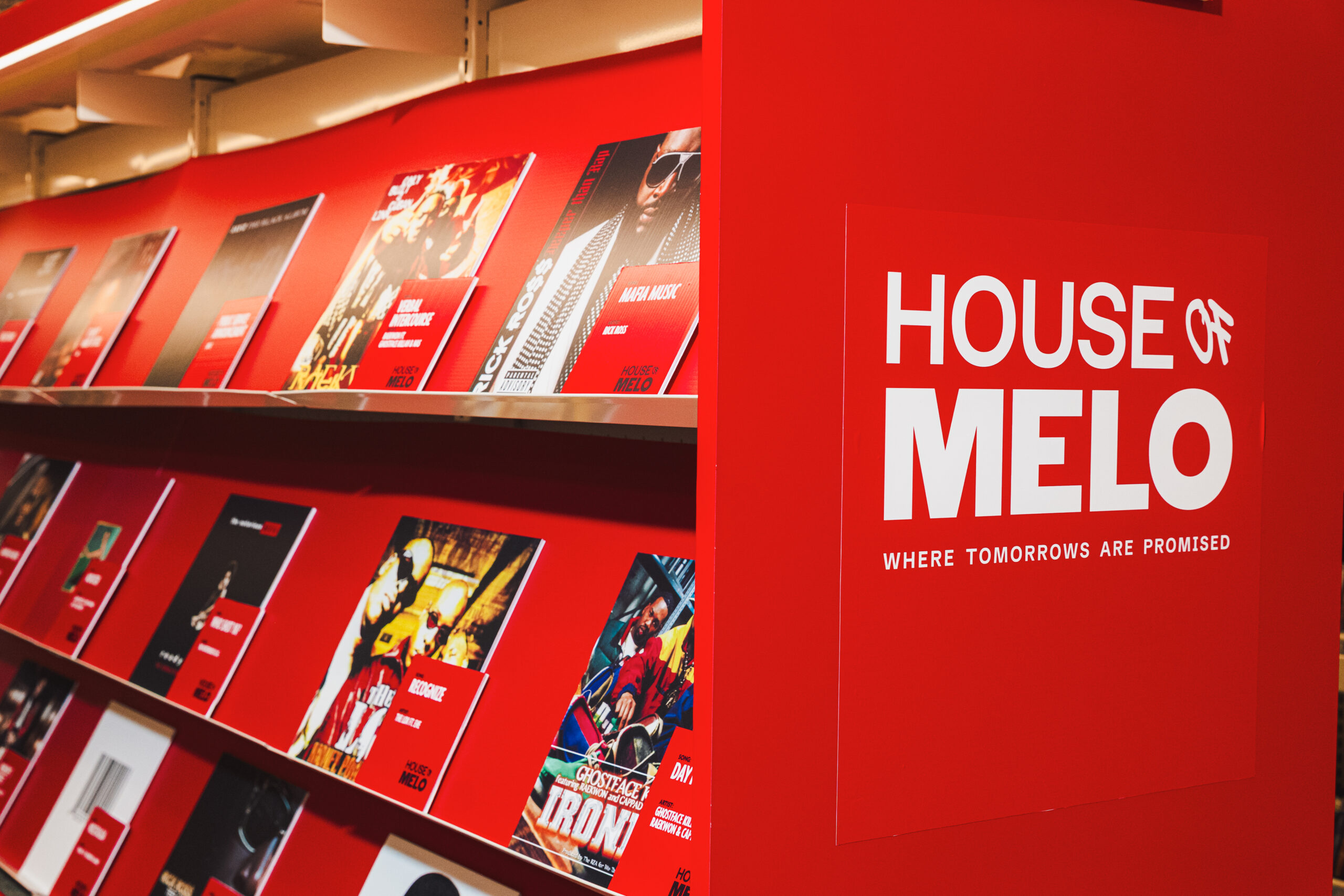
Where you would otherwise find typical audio and visual materials behind the computers, take in a bright display of 41 albums that feature Anthony’s favorite songs. It’s a soundtrack to his life. Rick Ross, Notorious B.I.G., Kanye West, Kendrick Lamar, Jay-Z, and Drake are heavily featured. “Hip-hop raised me, but I pulled from R&B, reggae, even my mom’s cleaning-day records,” the exhibit label reads. Scan a QR code for access to custom playlists, one with explicit lyrics and the other clean.
Cover Stories
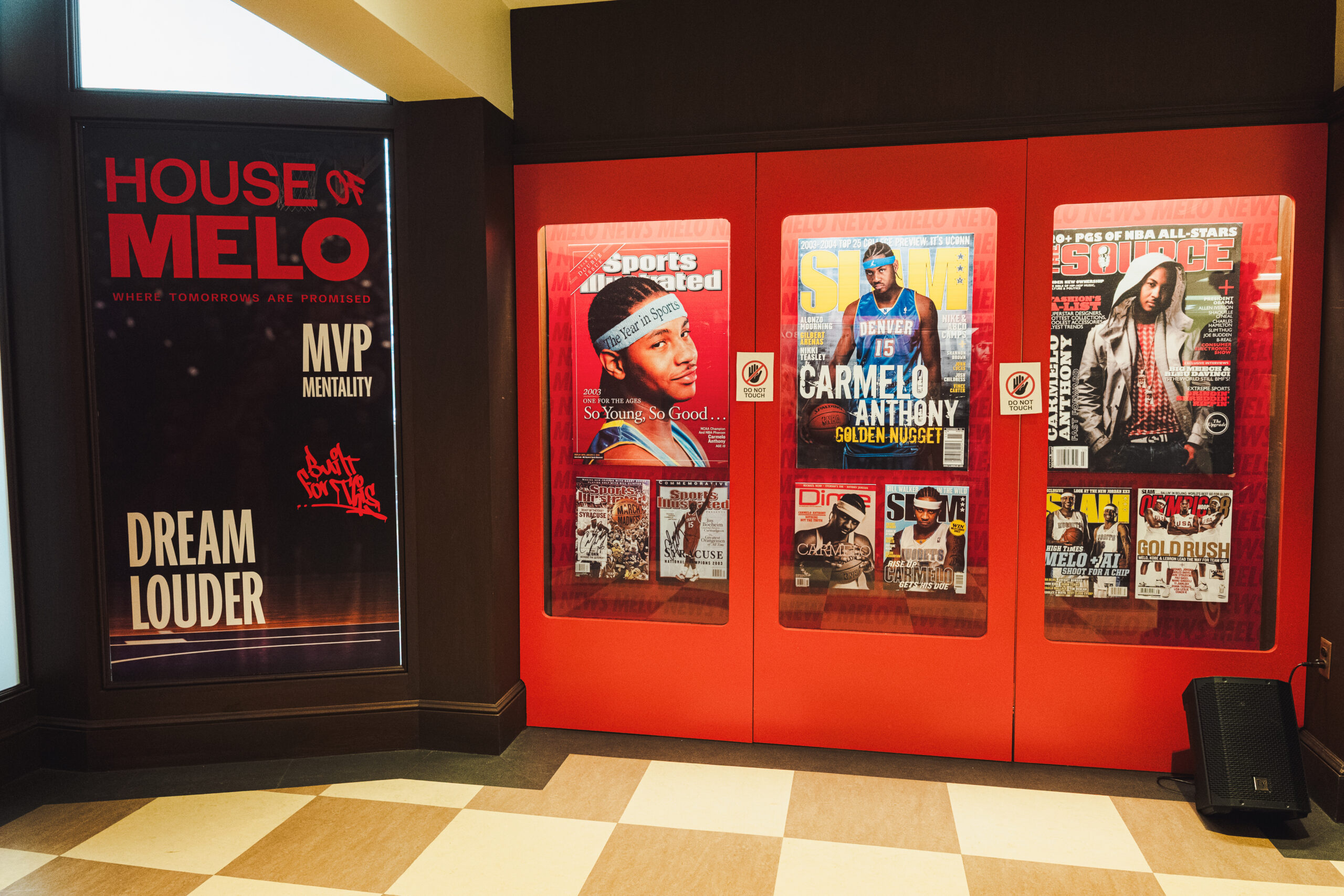
We’re partial to magazines around here, so, naturally, this is our favorite part. The “periodicals” section of the Central Library has been turned into a vestibule lined with giant archived covers that featured Anthony, including three Sports Illustrated and seven SLAM issues. “Each of these covers is proof the grind was working,” Anthony’s commentary reads. “They weren’t just my milestones—they represented my family, my city, my story coming to life.”
The Draft Suit
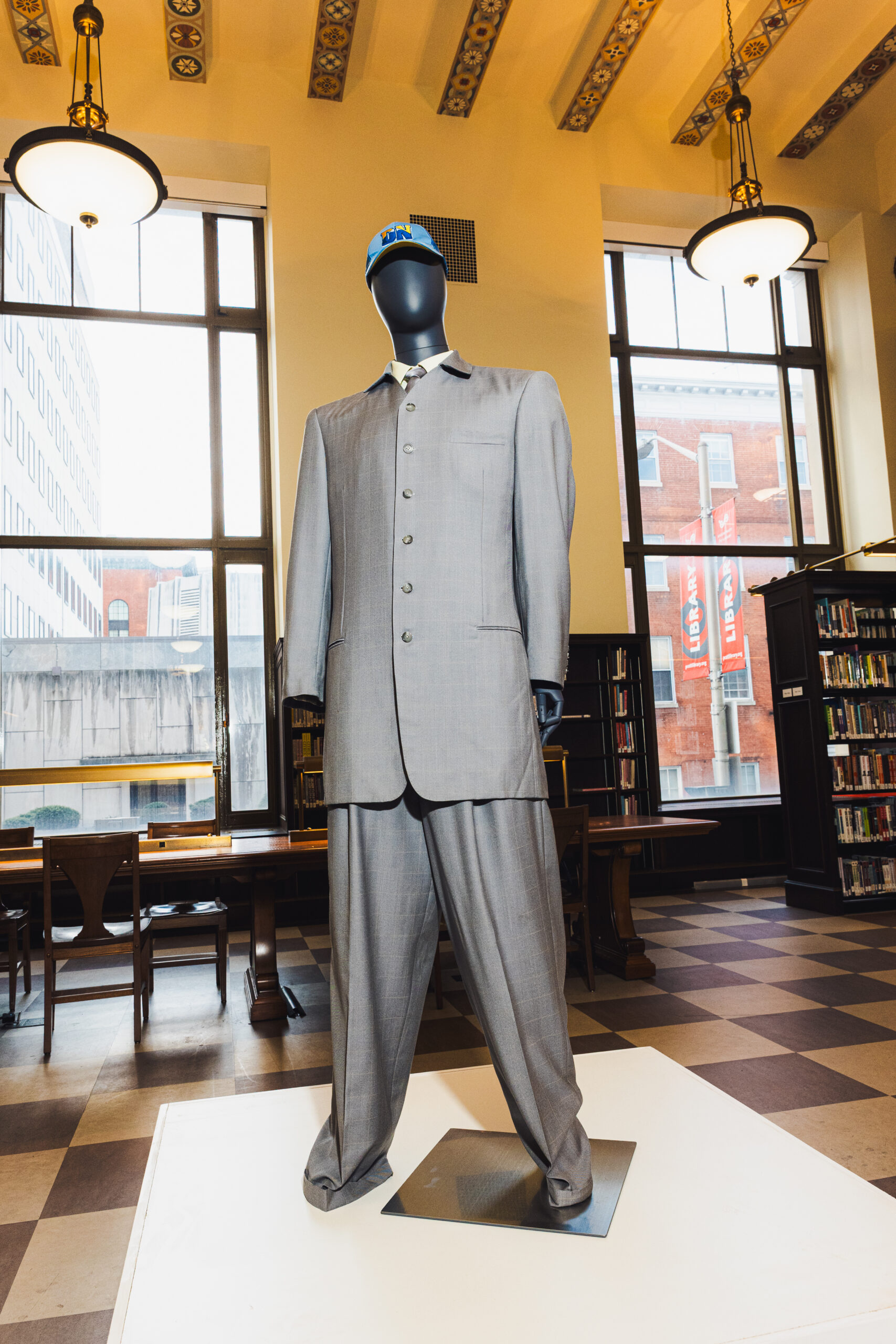
There’s a lot of Anthony memorabilia to peruse, but one item stands out: his 2003 NBA Draft suit fitted on a mannequin. It’s a story itself. The suit was notoriously ill-fitting on draft night—a product of early-2000s baggy era fashion—and it didn’t particularly age well, either. One of the most talented draft classes ever—including LeBron James, Dwyane Wade, and Chris Bosh—became mocked in NBA circles for their fashion choices. All these years later, the baggy pants of Anthony’s 5XL suit are still…big.
The Back Rooms
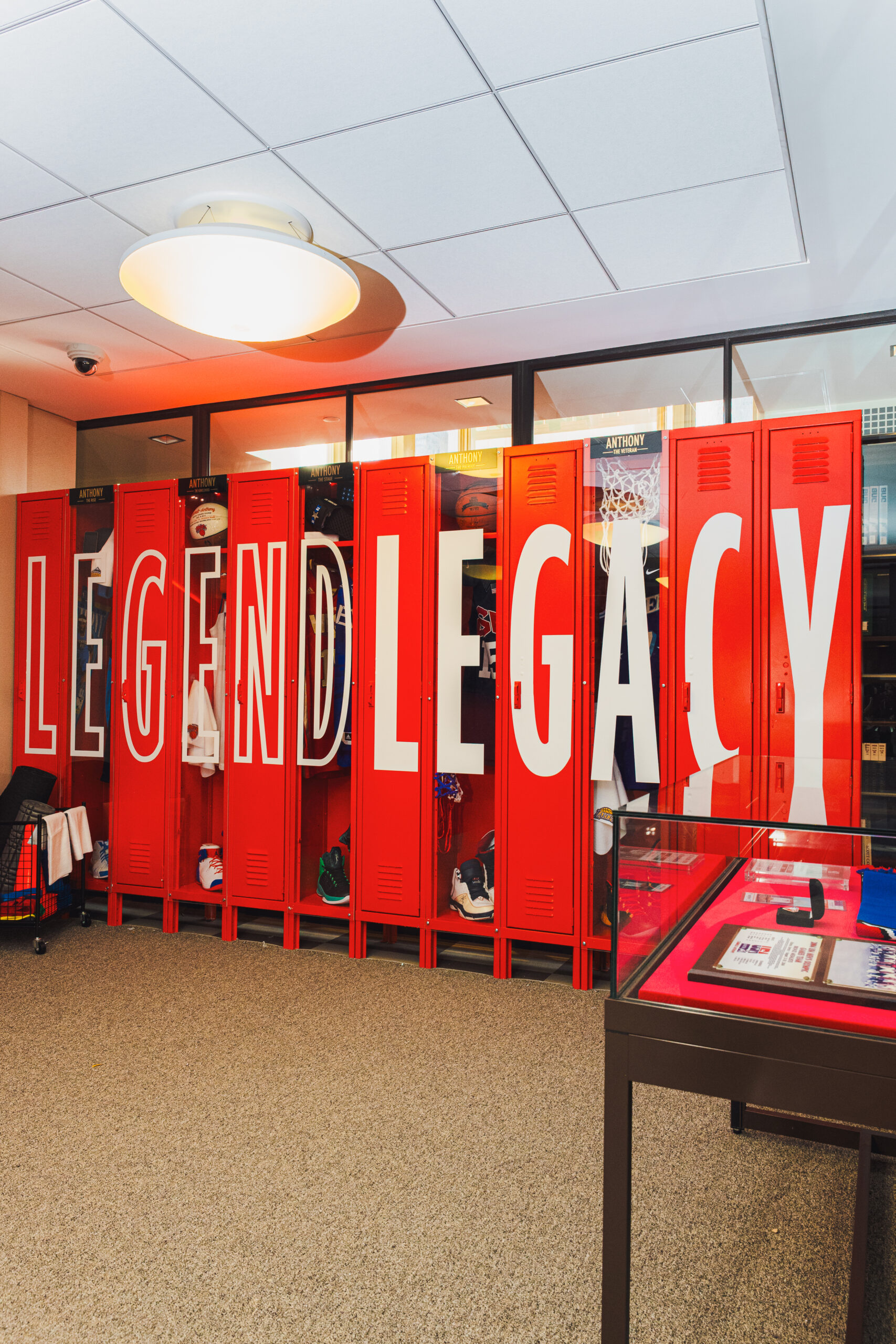
Tucked near the encyclopedias—and beyond a bank of “Stay Me7o” memorabilia highlighting Anthony’s Olympic accomplishments, his Top 10 all-time NBA scorer feat, and business interests—are two standalone classrooms that have been transformed. One is a “locker room” that marks each stage of Anthony’s basketball career, and the other a “boardroom” with references to Anthony’s past and present off-court ventures.
One very cool display on the boardroom wall shows early Nike sketches for one of Anthony’s custom Jordan brand basketball sneakers. “We’re curious about what you’d like to see done in Liquid Chrome?” a note on one sketch reads. Another annotation from 2012: “We will design an artful way to tell your 10 years of life with the Jordan Brand.”
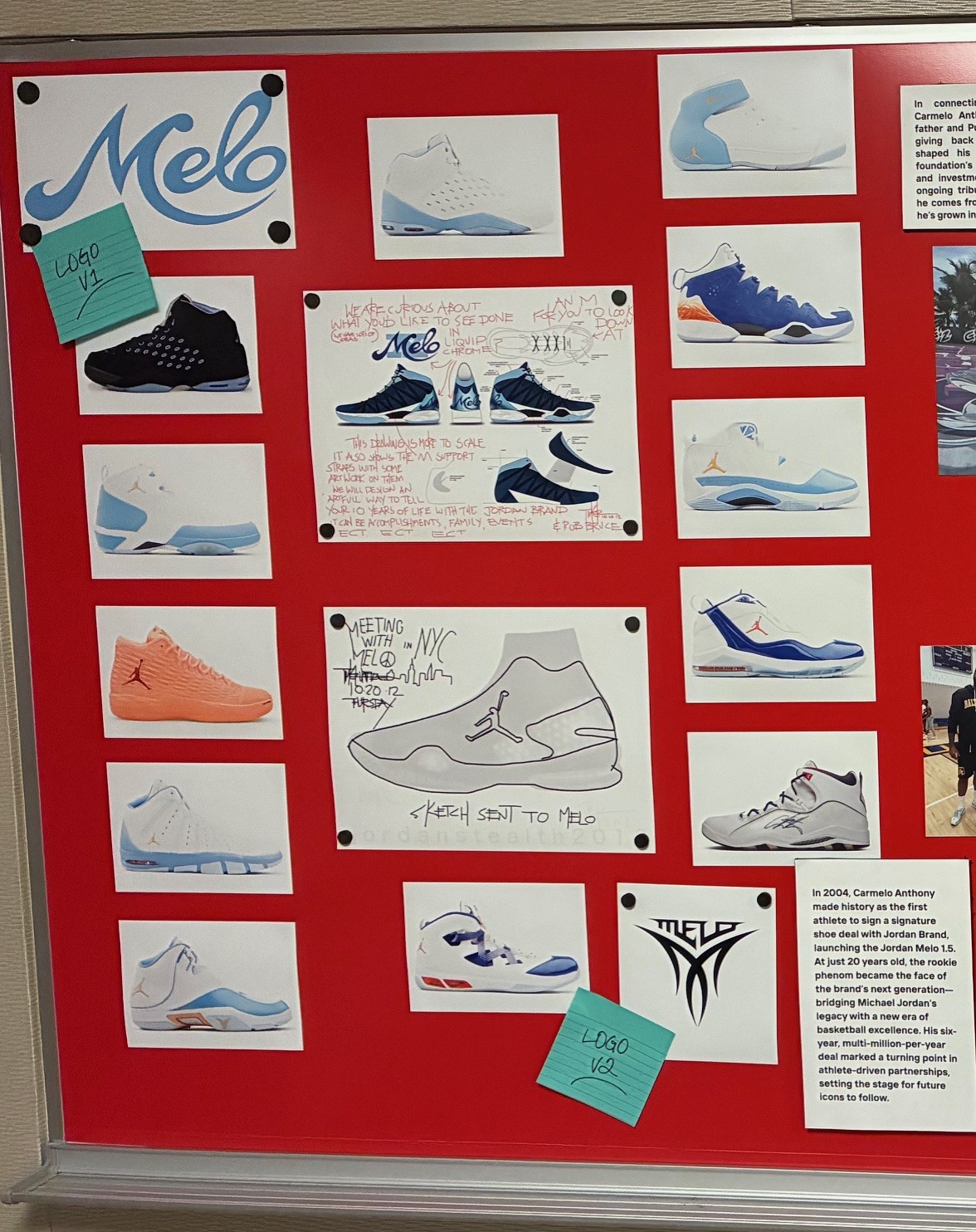
By that point, Anthony had been working with Nike for nearly a decade, having signed with Michael Jordan’s brand in the summer of 2003 before the NBA draft. Anthony became the brand’s first signature athlete with his name on a shoe, accomplishing what nearly every basketball-playing teenager in America sought: to pick up the NBA superstardom mantle from Jordan.
That path was forged in Baltimore, from the summer of 1992 when he arrived from Brooklyn through the frequent weekends now when Anthony says he visits the place he calls home.
What better place to document that full-circle journey than the city’s anchor library?