
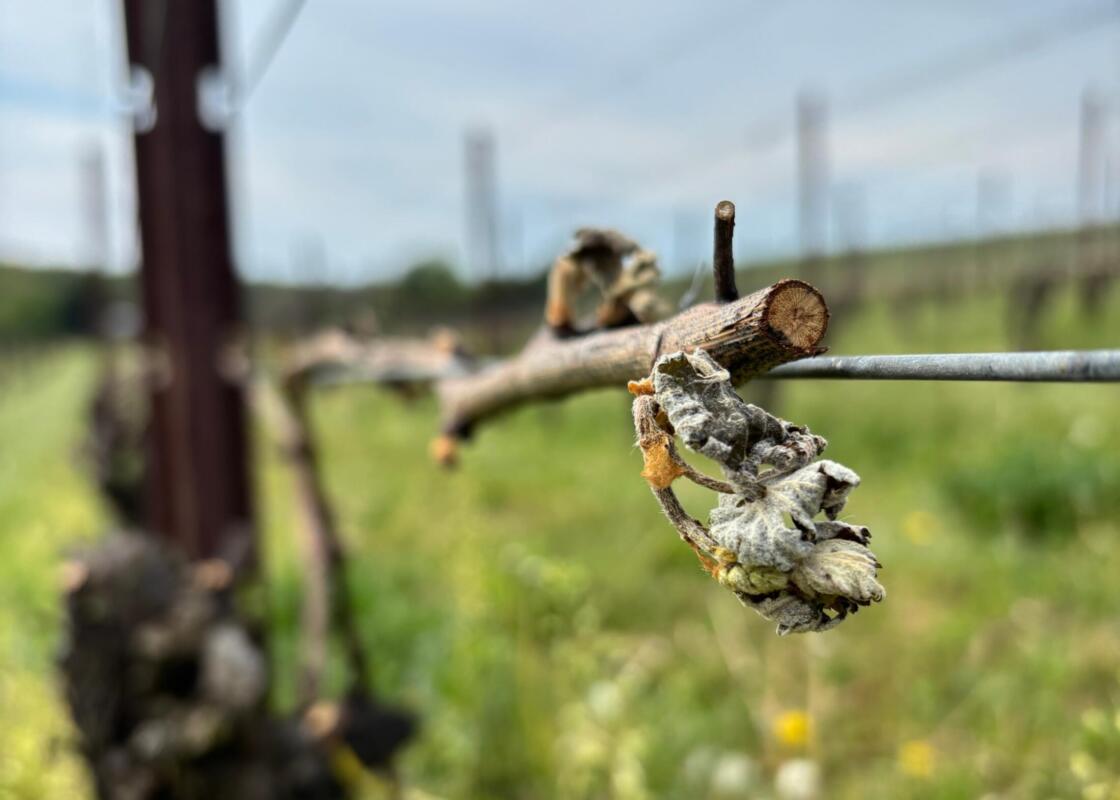
After a long, cold, snowy winter, things at Black Ankle Vineyards in Mt. Airy were looking good. Despite the “snow-ment” that coated the region for weeks, the vines had survived. Then, a perfect storm arrived.
An unseasonably warm spring, including several consecutive days in April with temperatures in the 90s, pushed the bud-break four weeks earlier than usual. Days later, April 21-22, an unprecedented and sustained frost—with temperatures reaching the low 20s for more than six hours—decimated those tender shoots.
“The leaves look like someone took a torch to them,” says Emma Pope, communications manager for the vineyard, which lost 100 percent of its bud-break in that one night.
It’s a devastating loss that can be seen across Maryland’s wineries. Such cold temperatures over a prolonged period of time thwarted the mediation attempts typically employed with a normal late-season frost. As one of the few vineyards in Maryland that is entirely estate produced—meaning they do not purchase grapes from anywhere off the vineyard—it’s particularly hard on Black Ankle. It’s likely that the entire 2026 vintage has been lost. Even if the vines put out new shoots and fruit, it will be smaller. And, ironically, it will ripen later in the fall, when fear of frost will again be an issue.
“We’re choosing to move forward with optimism,” says Pope, adding that the vineyard will fall back on its wine reserves to honor its commitments to wine club members and tasting room visitors. “We will likely cut our wholesale—sales to local wine shops and restaurants—to keep inventory. And our hope is we won’t have to buy outside fruit.”
In a statement, the Maryland Department of Agriculture called the April 21-22 event, “One the most significant crop losses in recent memory due to a late-spring frost,” particularly for the state’s wineries.
While the blame is falling on the frost, Pope explains it was the extreme heat that was really the problem.
“What set this apart was that bud-break was so early due to the extreme warm weather—everything was in grow mode,” she explains. “Usually when we have a late-season frost you will see some loss off the early-ripening vines, but we typically won’t have seen bud-break across the entire vineyard. That was what devastated us.”
Ava Marie, meteorologist with Baltimore’s media partner, WBAL-TV, says that many plants across Maryland got caught by a “false start” to the growing season.
“Despite the colder than normal winter, spring has been running several degrees above normal, triggering earlier-than-normal plant growth,” she says, adding that, “the recent cold snap in April was extreme, even by Maryland standards. On April 21, BWI Airport measured a low of 30 degrees, while areas to the north dipped into the 20s. Looking back at the records, that’s the coldest our area has been this late in the year in 70 years.”
Marie adds that longstanding drought conditions may have amplified the frost’s impact, as dry ground heats up faster during the day but also loses heat more quickly at night.
At Baugher’s Orchards & Farms in Westminster, which is a popular destination for pick-your-own fruits throughout the growing season, the damage is still being assessed. Dottie Dunn, who manages sales and purchasing at the farm, says they’ll know more in a few weeks when fruits form, but they’ll likely have less product with the same amount of labor.
“The results for our farm are less crops to pick and sell, and less crops for our customers who like to pick their own cherries, peaches, and apples,” says Dunn. “We still have to perform the routine orchard maintenance required to keep trees in good health, even if there is not much fruit on the trees.”
Two Boots Farm in Hampstead is known for its cut flowers, but they also have a significant pawpaw orchard. Owner Elisa Lane says they are still assessing the damage, but the morning after the frost, all the pawpaw flowers appeared dead. If the crop doesn’t survive, or is smaller than usual, it will mean, conservatively, a five-figure loss to the farm’s bottom line. They also lost all their spirea, a flowering shrub sold to wholesale florists and used in bouquets sold at farmers markets.
“Everything was going great,” says Lane, “but then we had the heat wave and all the crops were at least a week ahead of where they usually are.”
In the extreme heat, staff brought out shade cloth to try to preserve tender spring flowers. A week later, the shade cloth was off and staff were putting out row covers to protect plants from the frost.
Chasing after mercurial weather has become the norm at Two Boots. “This is what scientists have told us, that this is the direction weather is going, with more unpredictability and extreme weather events,” says Lane.
With cooler nighttime temperatures predicted this weekend, staff are once again pulling out the row covers to protect tender plants.
“Early spring warm-ups are becoming more common with a warming climate,” says Marie, “which puts plants in a vulnerable position, since the frost window in Maryland still extends into May.”
This is what concerns Pope. “We can deal with one bad season—the greater concern is will we be seeing this more often as weather changes get more frequent?”
Lane says it’s fortunate that her operation, which includes early-season plant sales and a variety of seasonal flowers, is diversified. If they were exclusively a pawpaw farm, the frost would have been catastrophic.
For Maryland’s vineyards, there is little recourse but to wait on Mother Nature and see what can be recovered. For many small operations, crop insurance can be too complicated and cost-prohibitive to manage. At Baugher’s, Dunn says there isn’t insurance for a killing frost, only hail damage. And Pope explains that insurance is generally for vine death. As the vines at Black Ankle are technically still alive (just not producing), insurance would likely not help.
For those who want to help farmers in need, the advice is simple: buy local. Lane encourages locals to come out to events like this weekend’s Flower Mart and Cylburn Arboretum’s upcoming Market Day and buy whatever vendors have to sell. She also suggests joining a CSA, or buying gift cards from farms that maybe don’t have product today, but will in the future and could use the cash flow now.
Dunn says farms appreciate when customers “accept some imperfect fruit and vegetables. As nature has it, not everything grows perfectly, and if we can’t sell the imperfect, it drives up the cost of what we can sell.”
“Buy local wines,” implores Pope, adding that the support from the community in the wake of the frost has been overwhelming. “It doesn’t even need to be ours—buy Maryland wines, Virginia wines, East Coast wines in general. There is this whole ‘buy local’ movement, but it often doesn’t translate to wines because people don’t think of it as an agricultural product. But, at its core, wine is a product from a farm, from farmers.”