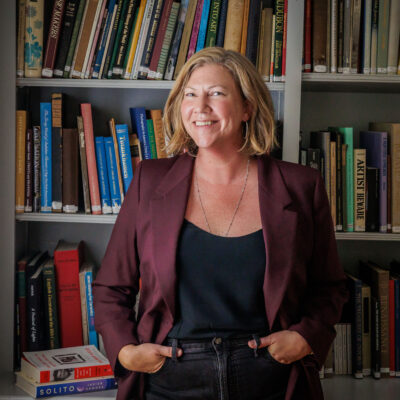
In our new Walk & Talk web series, we send a reporter and a local tastemaker to a Charm City cultural event and record their real-time reactions. Recently, arts contributor Kerry Folan met up with Bmore Art founder Cara Ober to explore BMA Celebrates MICA200, which is on view through January 3, 2027.
Blockbuster shows are always a good reason to plan a trip to the Baltimore Museum of Art, but the institution’s smaller permanent collection exhibitions can be just as rewarding—and, bonus, they’re free.
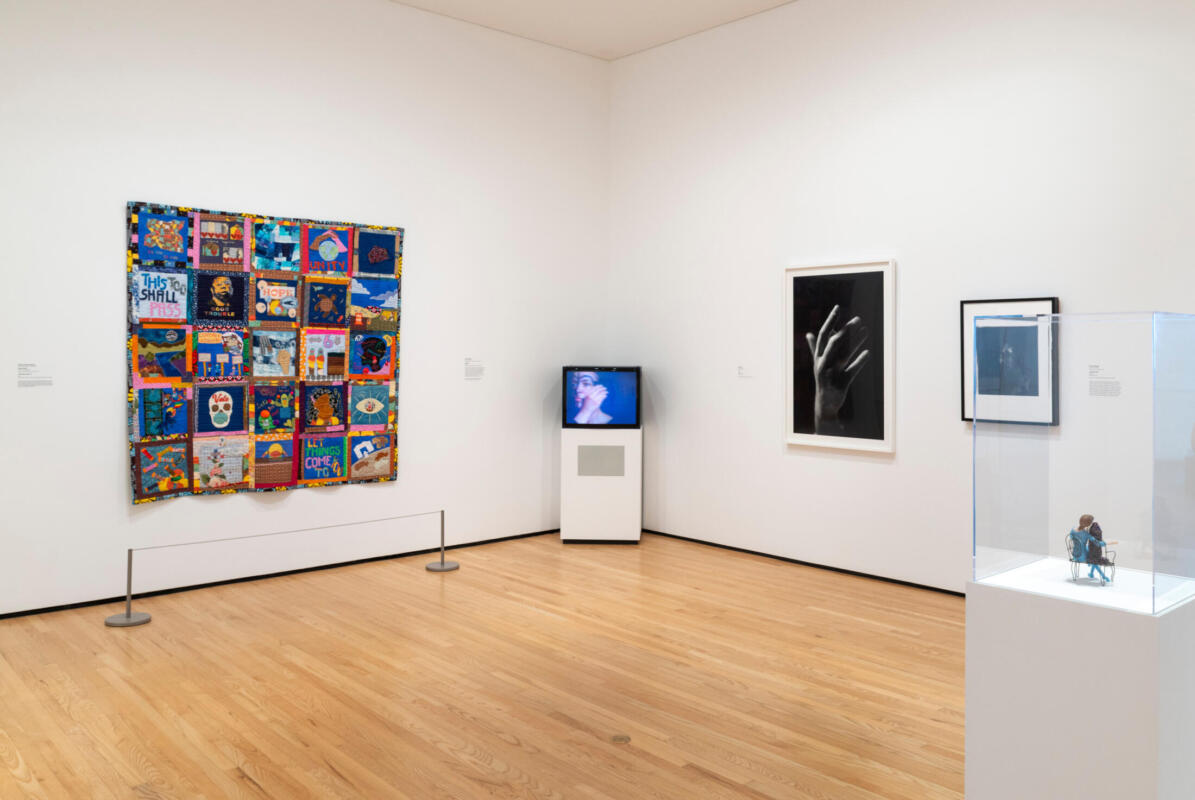
Case in point, BMA Celebrates MICA200, which is currently on view in the museum’s contemporary wing. This compact exhibition features 17 works by Maryland Institute College of Art (MICA) instructors and alumni—selected out of more than 500 in the permanent collection—that celebrate the longterm relationship between the museum and the city’s fine arts university.
The carefully selected pieces, plus others tagged throughout the contemporary wing, manage to represent the breadth of MICA’s output and impact throughout the past two centuries. The range is impressive, with painting, sculpture, photography, film, textiles, jewelry, and works on paper all represented. In particular, the exhibition highlights MICA’s tradition of pushing the boundaries of what craft can be—especially for socially minded artists.
Ultimately, the show emphasizes the ways in which each institution has supported the other’s mission throughout the years—a symbiotic relationship that is no small part of the reason Baltimore is home to such a vibrant arts community.
“MICA has played a major role in training and fostering that next generation of artists,” says one of the show’s curators, Antoinette Roberts. “That ethos is something that we share here at the Baltimore Museum of Art, which is why there are so many MICA artists in our collection, and why we’ve been engaging with MICA throughout the entirety of our existence.”
On a recent June afternoon, we toured BMA Celebrates MICA200 with one of MICA’s most ubiquitous and beloved alums, Cara Ober. Founder and editor-in-chief of the essential local arts publication Bmore Art, Ober graduated from the low-residency MFA program in 2004 and went on to teach at MICA as an adjunct professor for a decade.
Here, she shares her take on six can’t-miss works from the exhibition.
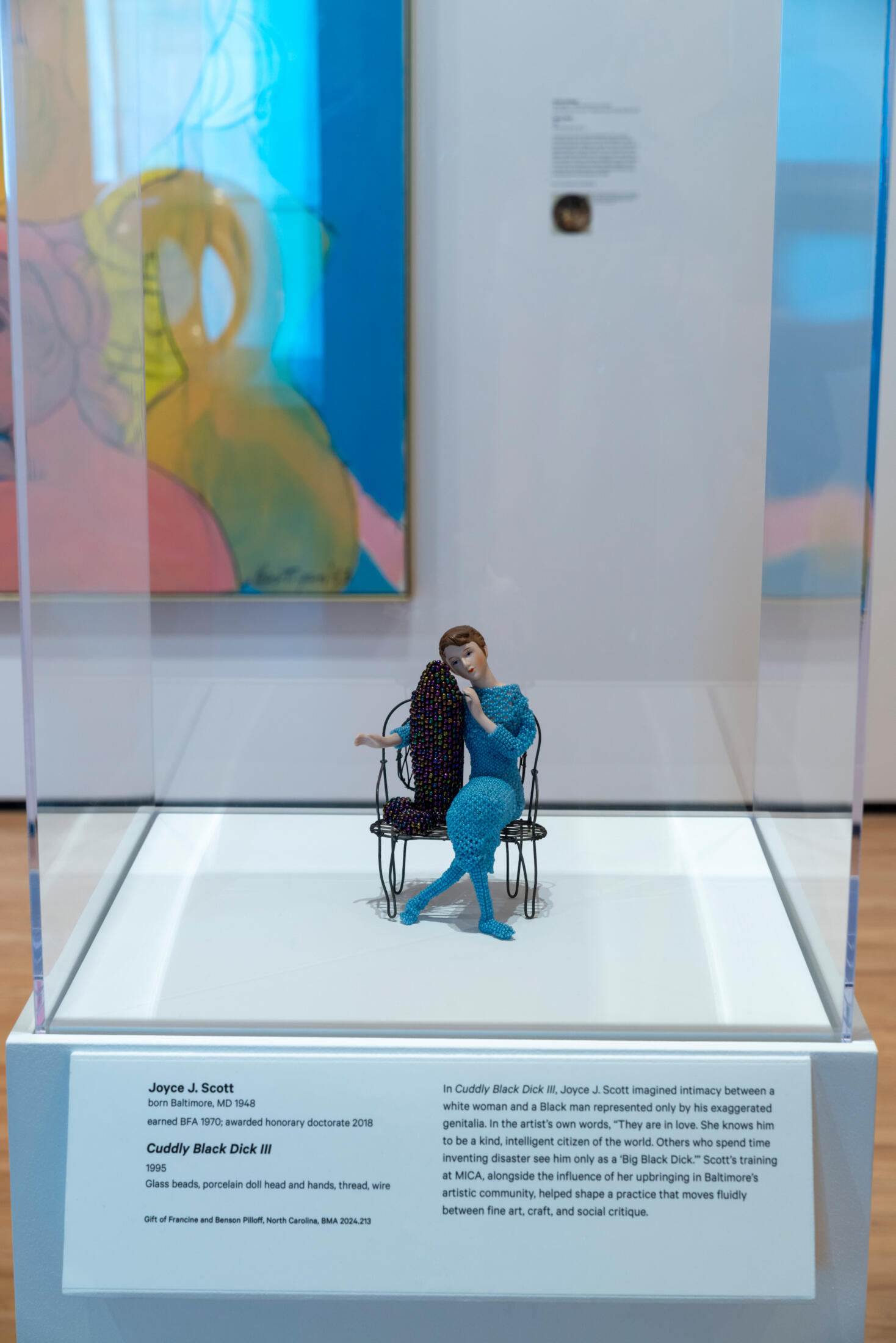
“Cuddly Black Dick” by Joyce J. Scott
1995. Baltimore Museum of Art, Gift of Francine and Benson Pilloff, North Carolina
“The first thing you see when you walk into the exhibition is this tiny sculpture. There’s a porcelain Hummel-type doll, a white woman, and she’s snuggled up to an iridescent, but definitely Black, beaded penis that is about the same size as her torso,” says Ober.
“You really do have to get in close before you’re like, ‘Oh, wait, that’s a giant dick, actually. Okay.’ And this doll/woman is lovingly caressing him/it. This piece really packs a wallop, so it’s fun to be greeted by it at the entrance. Joyce Scott steals the show from the first moment.”
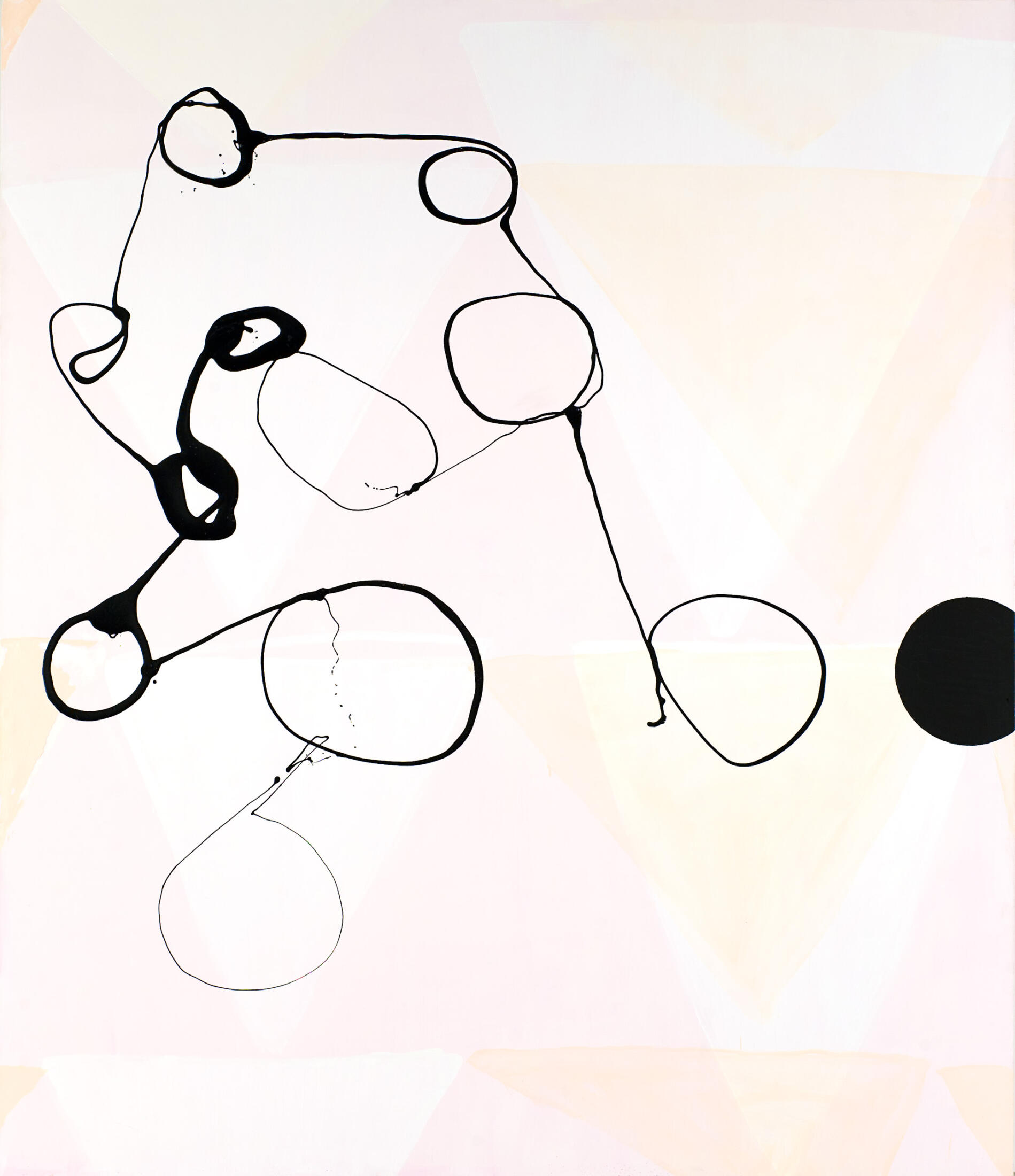
“Howling Mongrel” by Jo Smail
2004. Baltimore Museum of Art, Gift of Dr. Julien Davis, Baltimore, BMA 2016.11. © Jo Smail
“Jo Smail recently retired after a very long career teaching painting at MICA. In this work, we’ve got black, cursive, loopy line work, while the background has very simple triangles and circles and a very subtle pink skin color.
“You can barely see the triangles until you zoom in with your eyes, because the black lines on top are much more prominent. In the year 2000, Smail had a stroke and wasn’t able to speak for a little while. Her pieces from this time period have a raw power to them, a sort of unspoken language.”
“Ingres’ Bath” by Grace Hartigan
1993. Baltimore Museum of Art, Alice and Franklin Cooley Fund, BMA 1994.160. © The Baltimore Museum of Art / Estate of Grace Hartigan
“This is a later Hartigan. She started out as an abstract expressionist painter in the ’50s in New York, and she famously hung out with Willem de Kooning, Jackson Pollock, all the bad boys. She ended up in Baltimore because she got married, and she started teaching at MICA. She was the director of the Hoffberger School of Painting for a long time. I actually had my most brutal grad school critique ever with her.
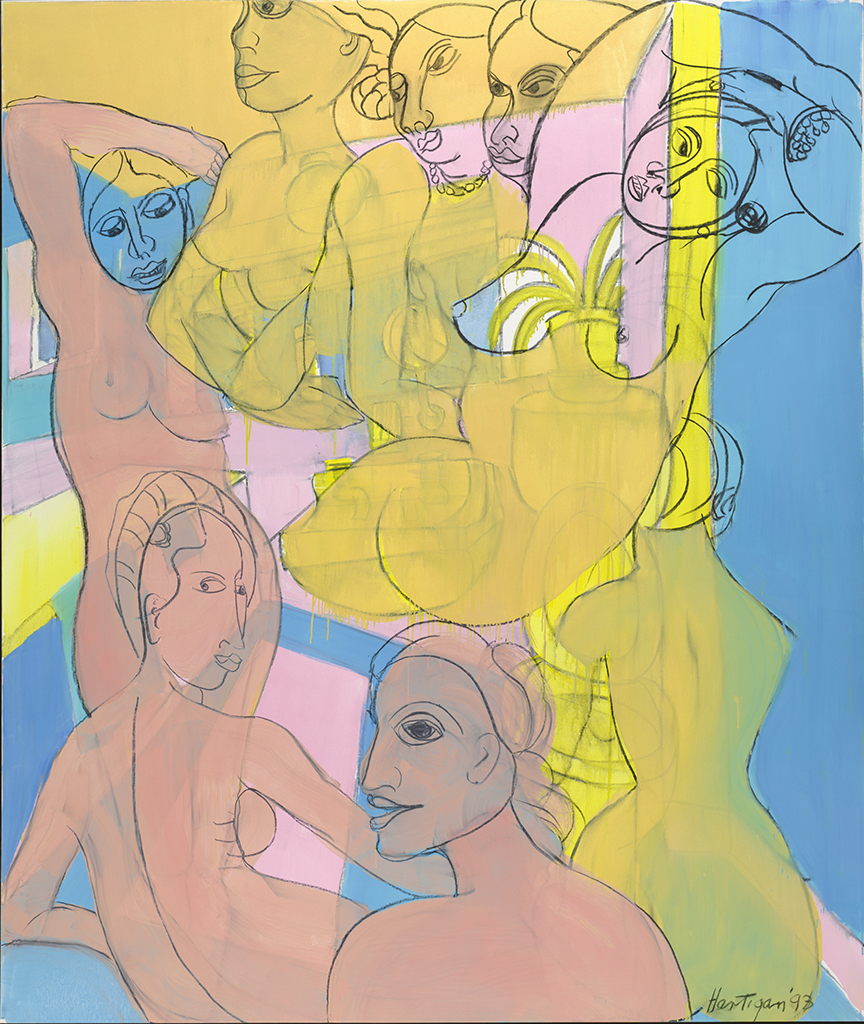
“The BMA has some of her large abstract pieces, and I think they’re really beautiful, but later on in her career, she decided that abstraction was over, and figurative art, like this piece depicting the human body, was where it’s at. That really attracted a lot of figurative painters to the Hoffberger program for many, many years.”
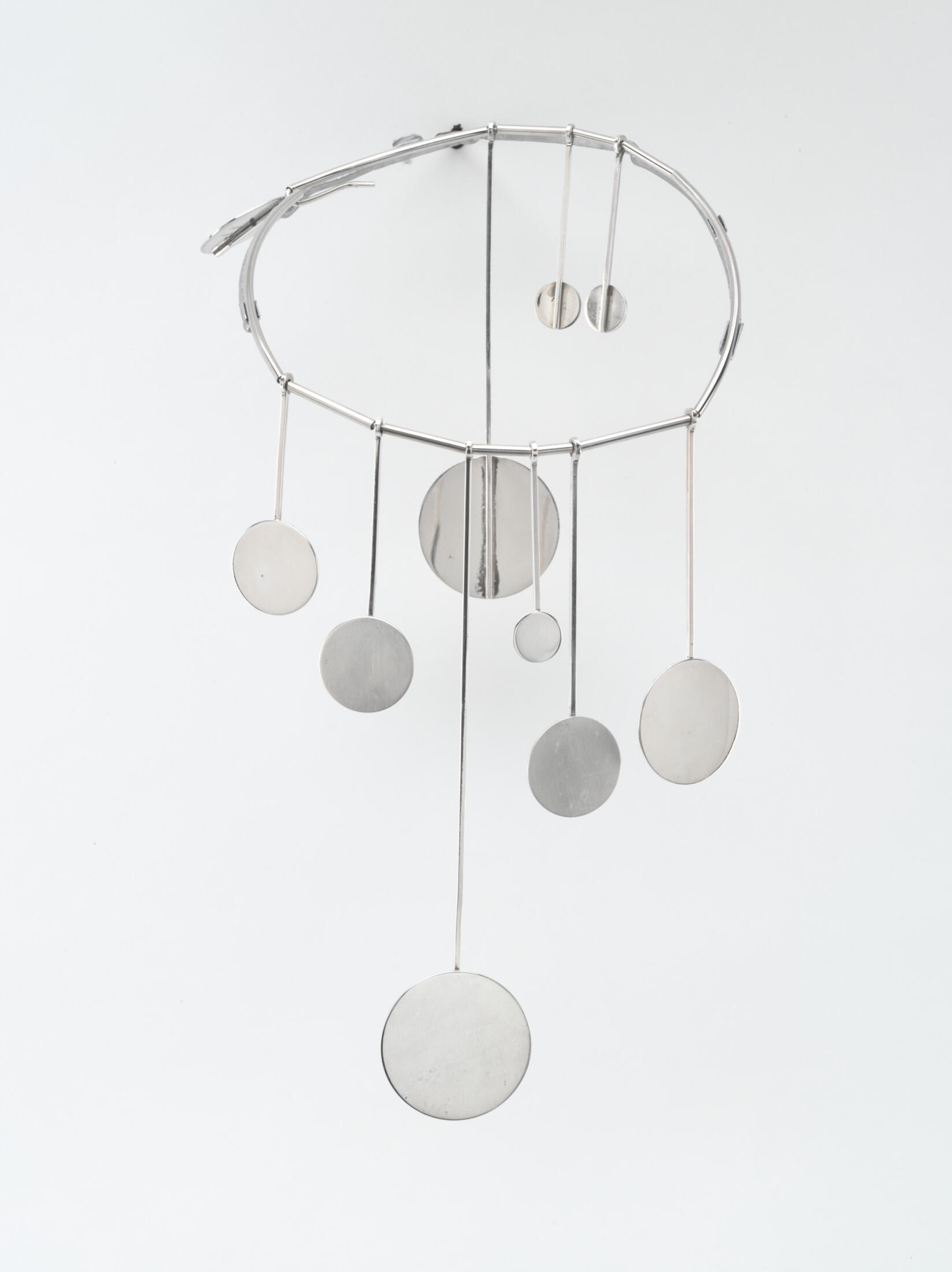
“Necksculpture” by Betty Cooke
1976. Baltimore Museum of Art, Gift of Barbara Katz, Baltimore, BMA 2019.7. © Betty Cooke
“Betty Cooke jewelry has been a calling card for women at art events for 50-plus years in Baltimore. This one has a bunch of different sized circles dangling from a choker. It reminds you of satellites. It reminds you of constellations. And it’s interesting that the circles are also in the back, so, for the wearer, from every angle there is going to be some level of detail.
“I’m always happy when there’s jewelry and functional pieces in museums, along with more traditional pieces. Oftentimes they’re separated now, but I think it’s important to recognize—this is art.”
“Mama’s Little Rock and Roll Baby” by Tom Miller
1991. Baltimore Museum of Art, Gift of Steven Scott, Baltimore, in Memory of the Artist, BMA 2015.366. © Estate of Tom Miller, Courtesy Steven Scott Gallery
“I like that this work is placed near Joyce Scott’s. The two of them were known to be close friends. [Miller] was the only Baltimore-based artist to have a solo exhibit at the BMA in the 1990s, so he was really an artist of significance before he passed away in 2000. He would collect found furniture, discards, and then transform them using this imagery that reminds you of childhood, with lots of bold color and pattern.
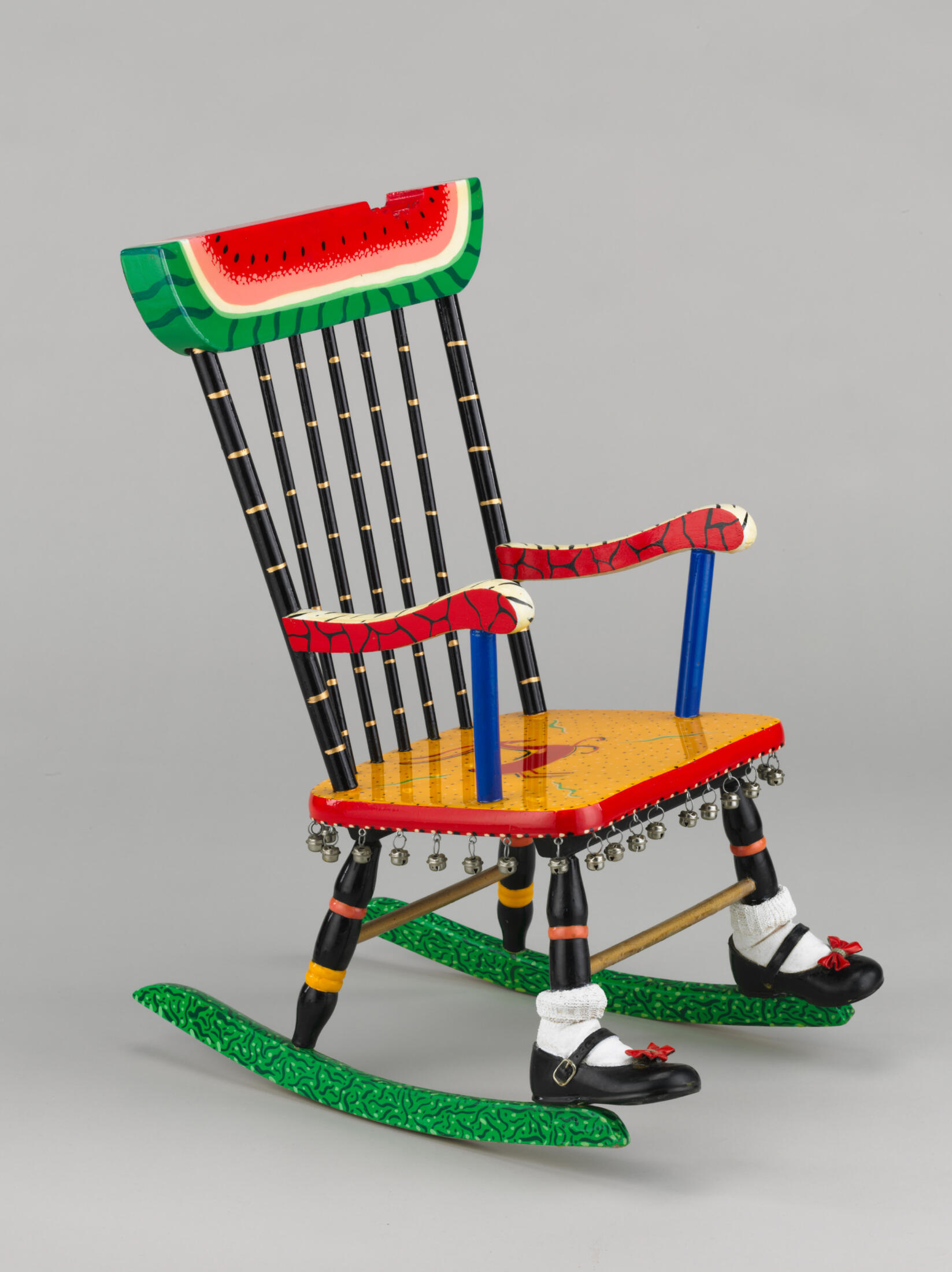
“There’s a real joy and celebration in his work, and it’s also kind of unassuming because it is on these castaway furniture items. He was also really thinking about Black culture and expression, and was instrumental in bringing Black artists to MICA.”
“Monarchy” by Taha Heydari
2020. The Baltimore Museum of Art: Purchase with exchange funds from the Pearlstone Family Fund and partial gift of The Andy Warhol Foundation for the Visual Arts, Inc. BMA 2021.160
“This work is so good. Taha Heydari is originally from Iran. He came here to study, and Doreen Bolger, who was the BMA director then, specifically commissioned a piece to help him to be able to stay here. A lot of his work is about having secular life erased with the Iranian Revolution. He talks about the fact that all the publications and the television could suddenly be deemed inappropriate or offensive and just be glitched out.
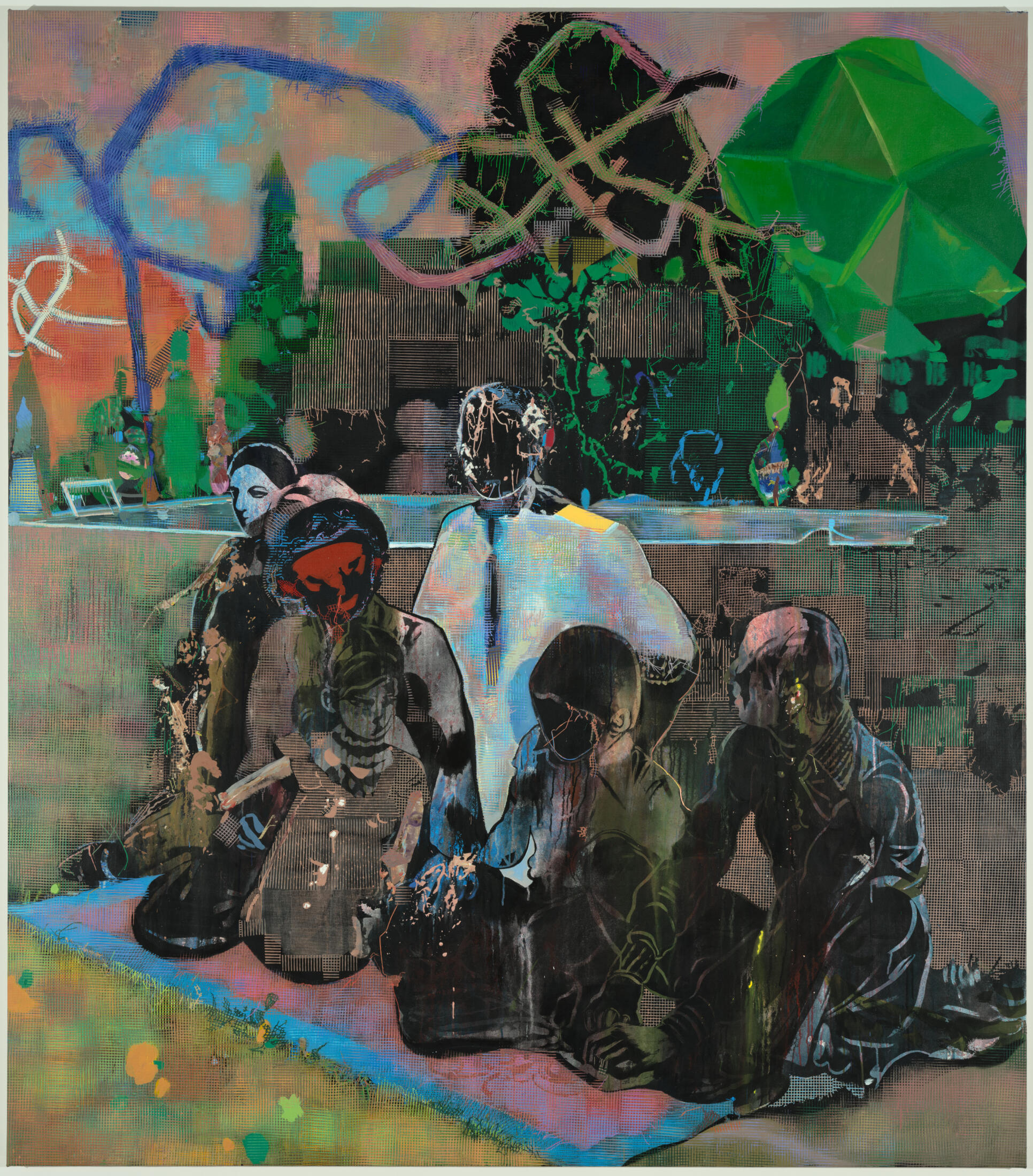
“He talks about the fact that all the publications and the television could suddenly be deemed inappropriate or offensive and just be glitched out.
“In his work, he blurs that line of family, memory, tradition, and surveillance, and visually it’s meant to evoke computer glitches. But it’s all done by hand. That’s the other crazy part. I think this piece really speaks to the way that Baltimore is a global city, and MICA is a huge part of that influence, bringing incredible artists, incredible talent, and incredible scholarship to the city.”
Know Before You Go: The exhibit is free and open to the public. In addition to the works selected for the show, pink wall labels on permanent collection works throughout the museum’s contemporary wing galleries—such as Heydari’s “Monarchy”—highlight pieces by other MICA artists, faculty, and alumni.