
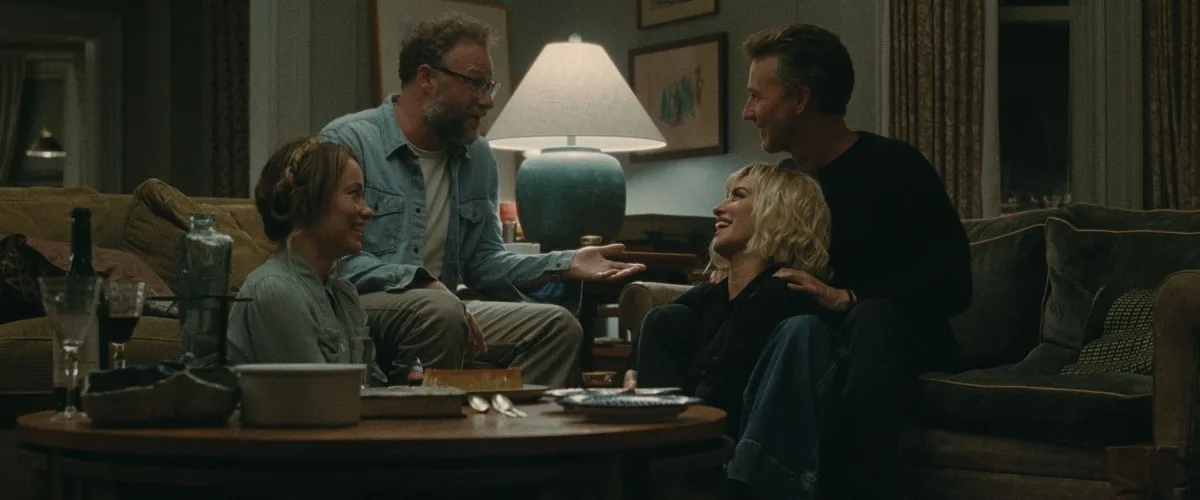
The Invite starts with an Oscar Wilde quote that perfectly sets up what we’re about to see: “One should always be in love. That is the reason one should never marry.”
Enter Angela (Olivia Wilde, who also directed) and Joe (Seth Rogen). They were in love once, allegedly, when he was an aspiring indie musician (his band had one minor hit and dissolved) and she was an art student. (She no longer practices her art.) They used to have a lot of sex, too, Angela claims. Great sex. But now they are living lives of quiet disappointment, if not quite desperation.
They no longer have sex. They have a 12-year-old daughter they love—she is the glue that keeps them together. He retreats to his home “studio,” to smoke pot and zone out. She redecorates the house—searching for creative fulfillment anywhere she can get it. The nice apartment they live in? It was the house Joe grew up in; he doesn’t even own it—a source of constant shame for him.
It is Angela who invites the mysterious and glamorous upstairs neighbors for dinner. When Joe comes home from work—he teaches music at a small college in the shadow of Berkley—he’s tired from biking up San Francisco’s hills. His back hurts, as usual. But Angela has been fussing. She has put out a spread—cheese, ham, bread, flowers—and is making a soufflé.
“Are we expecting company?” he says, mortified.
Yes, she says, the neighbors. I told you yesterday they were coming.
No you didn’t, Joe rebuts.
You never listen to me, Angela replies.
There’s something else about these neighbors—they have absurdly loud sex in the middle of the night. Joe and Angela always talk about them—like all long-married couples, some of their best conversations involve speculating about the private lives of others. Joe thinks their noises are selfish at best and performative at worst.
So Joe is pissed. Not just because the boisterous sex keeps him up at night but because he thinks the male in the relationship is creepy and makes too much eye contact in the elevator. If they’re coming, Joe says, I’m going to confront them about the loud sex.
They’re arguing over this when Hawk (Edward Norton) and Piña (Penélope Cruz, in a blonde wig) arrive.
Piña, of course, is gorgeous, preternaturally confident, sexy—she is played by Penélope Cruz, after all. Hawk (his ridiculous name is a source of cruel amusement for Joe) is, as advertised, a bit smarmy. The couple believes in radical honesty. We heard you arguing, they say. Angela tries to demur, “No…we….”
We were having a fight, Joe admits, adding, things are a bit contentious between us right now.
“We like contentious,” Hawk says.
“Well, you’ve come to the right place,” Joe cracks.
The guests take in the decorating that Angela has done—complimenting her taste and the “energy” she created. Joe rolls his eyes—he hates this kind of New Age bullshit—but Angela is overwhelmed. She starts to cry. “I was going for energy,” she sniffs. It’s clear that Angela wants to be seen—by Joe, of course, but by anyone. This is why the couples’ approbations overcome her like that.
The dinner party commences—well, to an extent. Angela has burned the soufflé. Piña is a gluten-free, dairy-free vegetarian, so she can’t eat the Jamón or the cheese Angela has put out (she picks at olives instead). And they are forced to break into their special occasion wine—and later tequila—to have something to drink.
Meanwhile, Joe keeps threatening to bring up the loud sex. In one hilarious scene, he tries to mention it several times but Angela keeps shoving the flan that Piña has made into his mouth to shut him up.
Wilde directs this inflamed dinner party with a swirling camera as though we are witnessing a mating/domination ritual. And the film’s string score combines playful jauntiness with elements of caustic and disruptive staccato. The film is extremely funny—at one point, Angela shows Hawk the three paint shades she is considering for the bedroom and it’s clear they’re all exactly the same—a white-ish gray. Hawk, pretentiously, suggests that one color feels like a walk on the beach, one feels like a hot morning on a Southern veranda, and one feels like a date with a stranger in Copenhagen. Angela’s mouth drops open. He gets it. “Joe thinks they’re all the same,” she says, shaking her head.
Things are relatively harmonious for a while, but we keep waiting for the other shoe to drop. Yes, the verbal sparring and tension recalls Edward Albee’s Who’s Afraid of Virginia Woolf? but this is as much a sex comedy as it an exploration of power dynamics among the couples.
Piña and Hawk, who occasionally converse in Spanish, who have a natural (or performative) physical intimacy, and who sometimes regard Joe and Angela like they are amusing children, clearly have the upper hand. But the power dynamics will shift throughout the night. And maybe, just maybe, Piña and Hawk aren’t as perfectly content as they seem.
Olivia Wilde, working off a script by Rashida Jones and Will McCormack, has hit a home run here. The film is uproariously funny and sexy but more than a little sad, too. Is it too late for Joe and Angela to find their way back to each other? Or is their marriage the very thing that has doomed their love?
The cast is note perfect, with Rogen evoking cranky, funny, neurotics like Albert Brooks and Woody Allen and Wilde—emotional, frazzled, unaware of her own beauty— evoking Diane Keaton. Cruz has the sexual confidence of Anne Bancroft in The Graduate and the self-satisfied Norton is reminiscent of Alan Alda in Crimes and Misdemeanors. Yes, there’s a reason I’m recalling stars of yore. The Invite feels like a throwback to the grown up films of the ’70s and early ’80s. What an absolute pleasure. Grownups are back, baby!