
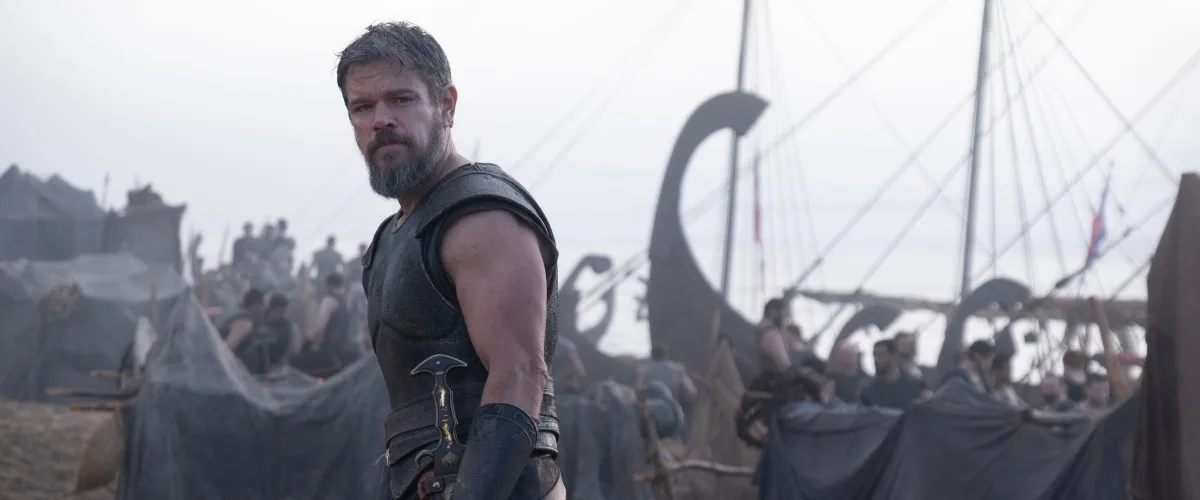
There’s a reason why Christopher Nolan keeps suggesting that you see his The Odyssey on the largest screen possible—ideally, in IMAX. If nothing else, the film is a spectacle—a technical triumph that brings all the magic, bloodshed, and mythology of Homer’s epic to life.
Ever wondered what it was like inside the Trojan Horse? Wonder no more. Ever asked yourself what it felt like for the soldiers of Ithaca to take on a Cyclops? It was apparently terrifying (and a little sad). We see it all—the depths of Hades, the deadly allure of the Sirens, and, in one remarkable scene, the witch Circe (Samantha Morton) turning Odysseus’ army into a pack of grunting hogs.
We have the technology. And we also have a master of action who can choreograph all of these elaborate set pieces with intensity, clarity, and awe.
I confess I’ve never read The Odyssey (I did my thesis on James Joyce’s Ulysses, if that counts (it doesn’t)). But we’ve all learned the story through cultural osmosis. We know one of its major themes is a primal desire for home, which happens to be an obsession in many Nolan films—from Interstellar to Inception to Dunkirk. Here, Nolan also grapples with the Golden Rule—in the film it’s called Zeus’ Law. The idea is to be kind to strangers, lest they be gods in disguise.
But are the gods even real? In the film, they are depicted as real—although Athena (Zendaya) only comes to Odysseus (Matt Damon) as an apparition. But the Cyclops—massive, with a one enormous eye and a nose twisted to its side to make him look like a giant Picasso painting—is real. As is the righteous magic of Circe, the omniscience of the denizens of the underworld (here called Hades), the power of goddesses, and so on.
But Nolan also leaves room for the idea that gods were conjured to explain the horrors and mysteries of nature. When Odysseus’ ship is wracked with deadly storms and waves, his crew believes it’s because he has angered Poseidon. There’s an angry god to explain every natural disaster, every tragedy that befalls man.
So, the plot: Odysseus leads an army into Troy, knowing the mission is possibly futile, if not doomed completely. Meanwhile, his devoted wife, Penelope (Anne Hathaway), waits for him for 20 years, fending off dozens of would-be suitors, who stay in her castle like it’s a gilded Holiday Inn. Odysseus’ son, Telemachus (Tom Holland), was just a baby when Odysseus left for war—he doesn’t know his father, but he idolizes him all the same. He hears wonderful stories of Odysseus’ decency, bravery, and honor, from not just his mother, but from his father’s loyal servant, the now blind and enfeebled Eumaeus (John Leguizamo). Like many blind men of mythology, Eumaeus can “see” what other men can’t. There is also Odysseus’ bedraggled, loyal hunting dog, half dead, waiting for his master to come home. (Nolan is laying it on a little thick here, but who am I to grumble over a cute dog.)
Of the would-be suitors, the most attractive—and malevolent—is Antinous (Robert Pattinson), who sees young Telemachus as a threat to the throne and plots to kill him.
The film toggles back and forth between life with devoted Penelope and the many trials of Odysseus and his crew. Penelope insists she will pick a suitor once she finishes the funeral shroud she has been weaving for years. However, every night, she unravels the work of that day. When he’s old enough, Telemachus travels to Sparta to learn something—anything—about the whereabouts of his father, a trip that will imperil both him and his mother.
By now, the war is essentially over. Odysseus is presumed dead, but in fact, has been a captive, of sorts, of the goddess Calypso (Charlize Theron), who healed his wounds and has been feeding him lotus flower to cloud his memory for seven long years.
Is it spoiler to say that Odysseus eventually makes his way home? (This is less a spoiler alert and more of a “know your classic literature” alert.) He disguises himself as a beggar—and we get a little Good Will Hunting action. Never underestimate Matt Damon, especially if you think he’s beneath you.
Damon, I should say, is an excellent Odysseus. The 55-year-old actor got jacked for the role and he seems powerful, even as an old man with a white beard wandering around in a tattered toga on Calypso’s island. Importantly, he manages to convey the wisdom, kindness, and practicality of Odysseus. Like all great leaders, he must make difficult choices. Sometimes a few men need to be sacrificed to save the rest.
Most of the acting is solid, with Hathaway able to do some enjoyable scenery chomping as Penelope, ever imperious and regal but nearly driven mad with grief. In their few scenes together, she and the mustache-twirling Pattinson get to fight over who can devour the scenery more greedily. Go off, you two. Holland is fine as Telemachus—he brings an earnestness and sturdy physicality to the role. He’s likeable, as ever, but just not that interesting? (Or maybe that’s just compared to the histrionics of Hathaway and Pattinson.)
Other standouts in the cast include Leguizamo, Morton—the film really comes to life once her Circe appears—and Himesh Patel as Odysseus’ faithful (to a point) deputy.
Again, I’m not able to point out discrepancies between the film and the original text, but there is one element to Nolan’s Odyssey that feels very modern, very much him: Odysseus’ guilt over the destruction of Troy, which mirrors Oppenheimer’s guilt when he sees what his atom bomb has wrought. I’m not sure Odysseus was that in touch with his feelings back in 1200 BCE.
Still, it’s Nolan’s party and he can do what he wants with it. He’s succeeded in many ways—bringing a classic epic poem to life, modernizing it, but certainly not in a thoughtless way, and utilizing the full range of his prodigious cinematic toolkit. Did I love it? Not quite. I prefer more a little more character development and a little less spectacle. But it’s going to be a lot of people’s favorite film (okay, mostly dudes). And yeah, it’s more than good enough to earn that honor.