
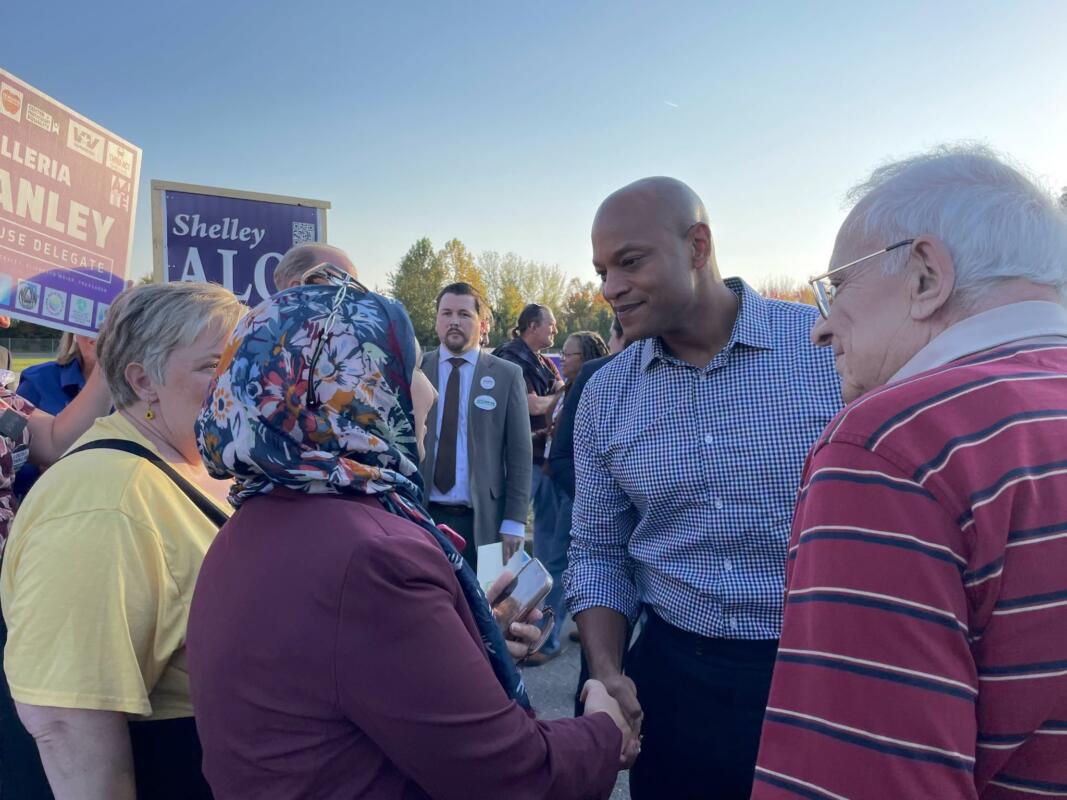
Maryland Gov. Wes Moore, the first Black governor in the history of the state, easily won re-election Tuesday night. Moore defeated Republican challenger Dan Cox for the second straight time, once again earning more than 60 percent of the vote.
There were no real major surprises in Maryland, nor were any potential upsets or surprises predicted. Incumbent Comptroller Brooke Lierman and Attorney General Anthony Brown also handily won re-election. The state’s six Democratic members of Congress—including Baltimore’s Kweisi Mfume, who earned his 10th term overall—maintained their seats as did Maryland’s lone Republican House member, Andy Harris.
In other statewide news, Question No. 3 on the ballot, Maryland’s redistricting referendum—designed to boost the Democratic Party’s chances of carrying all the state’s congressional districts—passed by a wide margin.
“I want to be clear, I still hate partisan gerrymandering,” said Moore, who backed the measure and is widely believed to be considering a 2026 presidential bid. “But do you know what I also hate? I hate when the wealthy and well-connected try to rewrite the rules to benefit themselves while the rest of us are supposed to abide by a different set of rules.”
In Baltimore, City State’s Attorney Ivan Bates won unopposed. Also, ballot Question No. 1—“the Baby Fund” charter amendment to create a dedicated funding mechanism to assist the economic stability of families with newborns—passed with 80 percent of the vote.
“The Baltimore Baby Fund is an opportunity to provide evidence-based support to families of newborns in our city, building on the success of our guaranteed income pilot program,” Mayor Brandon Scott said last month in announcing his support for the measure, which had received committed grassroots support and 10,000 signatures to get an amendment on the ballot. “We know from experience—and from research—that direct cash payments to parents is one of the best ways to help families and young people succeed in the short and long term.”
In Baltimore County, Julian Jones became the county’s first elected Black executive, garnering more than 62 percent of the vote. In Howard County, Vanessa Atterbeary became the first Black woman elected executive.
The big news in the mid-term elections, however, came in the U.S. House, U.S. Senate, and in gubernatorial races around the country.
The Democrats were projected to regain control of the House of Representatives, but a “blue wave” left no doubt of voters’ repudiation of President Donald Trump and his administration’s policies. The margin of victory was beyond anything predicted by poll or pundits. Depending on the outcome of a number of close races around the country, Democrats could end up with as many as 258 seats in the House.
More surprising, the Democrats swept into firm control of the U.S. Senate as well—winning seats in longstanding Republican strongholds of Texas, Kansas, Iowa, and South Carolina; flipping seats in Ohio and Maine; and potentially winning Mississippi and Alaska. (Votes were still being counted as of press time.)
Democrats also took gubernatorial races in traditional red states, including Georgia, Iowa, Texas, and Ohio, capturing a majority governor offices for the first time in 16 years.
Among several statewide “firsts” Tuesday night, Georgia voters elected the state’s first Black governor in Keisha Lance Bottoms, Texas voters elected the Lone Star state’s first Latina governor in Gina Hinojosa, and Michigan voters elected the first Muslim, Abdul El-Sayed, to the U.S. Senate.
“Americans have made it clear: they want a Democratic Congress to take on Trump, his illegal war, and the rigged economy,” Maryland Senator Chris Van Hollen posted to X, summing up the historic results. “We can’t just fight back against Trump—we’ve got to fight FOR a better future for working people. It’s on us to deliver. Let’s get to work!”