Business & Development
General Ship Repair is a Testament to Baltimore’s Maritime Roots
The south side of the Inner Harbor used to house convoyed rows of such shipyards, but now there is only this one—which has been operated by the Lynch family for more than a century.
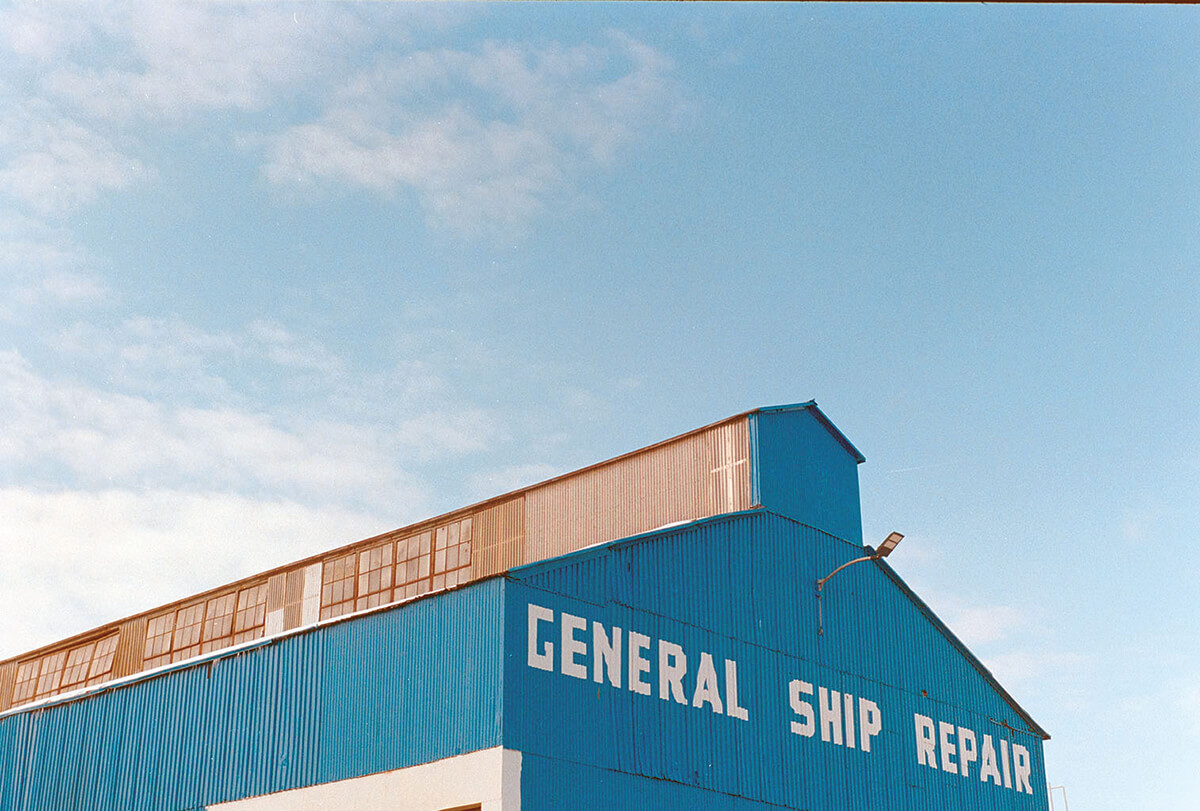
On the south side of Baltimore’s Inner Harbor, jigsawed between the Domino Sugar refinery and the Baltimore Museum of Industry, sits The General Ship Repair Corporation. Where once there were convoyed rows of such shipyards along the Inner Harbor, now there is only this one, a family-owned yard that’s been in operation for more than a century. In fact, it’s one of just three ship repair works still in operation in the greater Baltimore area—the other two are in Curtis Bay—one of which only repairs Coast Guard vessels.
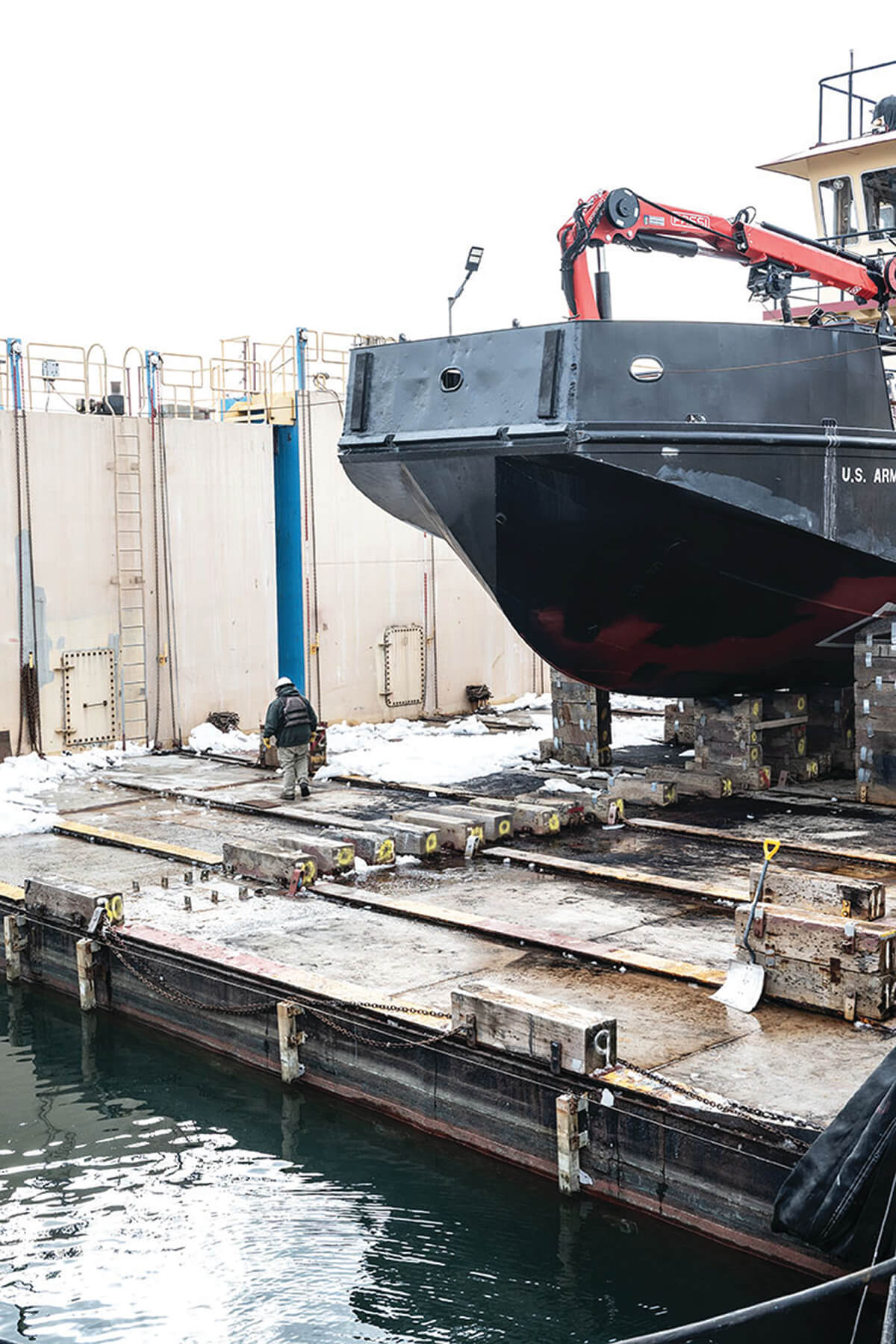
General Ship Repair (GSR) is a testament to the city’s maritime roots and the long history of the port of Baltimore, as well as a reminder that this whole stretch of the Inner Harbor was once composed not of hotels and condos, but of those shipyards. Situated on a two-plus-acre stretch between Key Highway and the Patapsco, it’s composed of a pair of old brick buildings; one shop each for fabrication, machinery, and electrical repair; and two 1,000-ton floating dry docks.
GSR’s endurance is also a testament to the Lynch family, who founded the business in 1924 and still owns and operates it. Charles “Buck” Lynch first started GSR as a small marine machine shop on Light Street, in the location that’s now home to the Baltimore Hyatt Regency. He moved the shipyard a mile and a half down the road to its present site in Locust Point in 1929. The business went bankrupt during the Great Depression, but Lynch managed to buy it back at auction and to grow the shipyard, which, during the height of World War II, employed as many as 600 workers. Over the years, the company has repaired and serviced schooners, steamships, paddle-wheelers, tugs, tour boats, and super tankers.
Sitting in his wood-paneled office on the second floor of the original building, photographs and paintings and ship paraphernalia from the last hundred years lining the walls, Ryan Lynch, the company’s current president and Buck’s great-grandson, downplays his family’s legacy.
“We fix ships,” he says of his team, which now numbers 45, conceding that it is kind of a broad description.
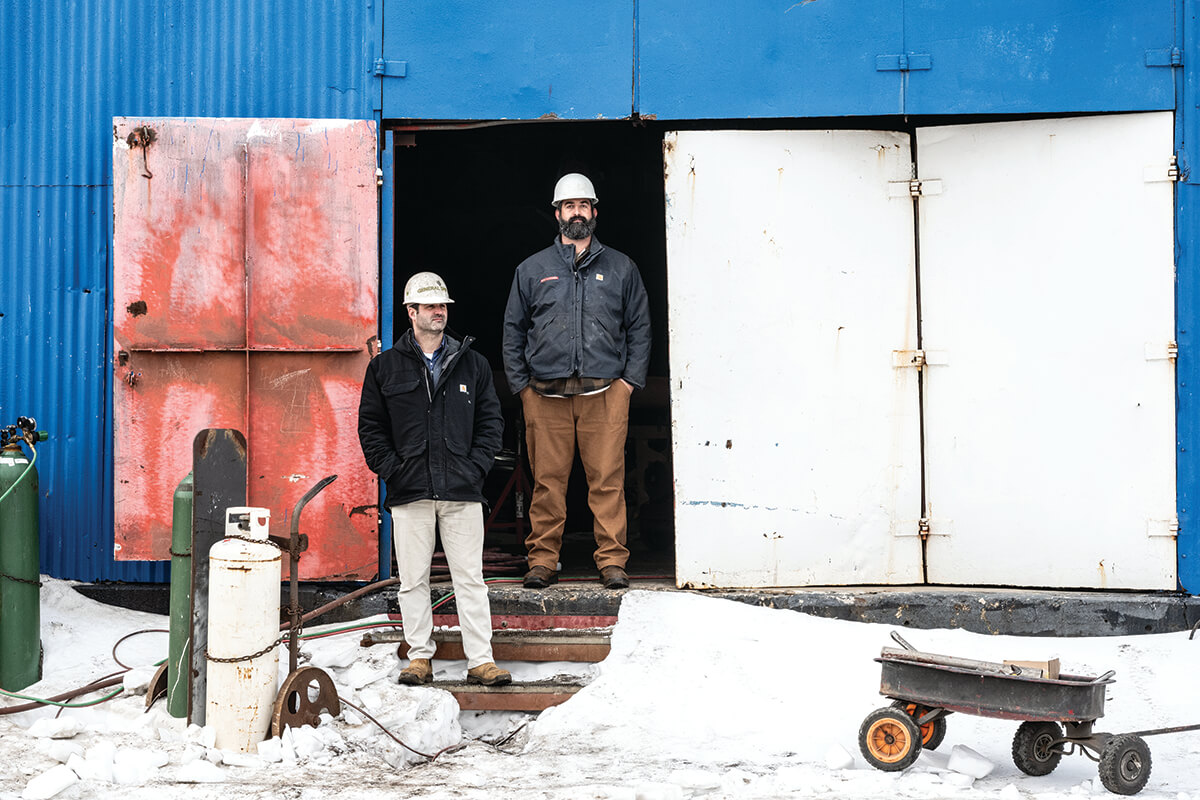
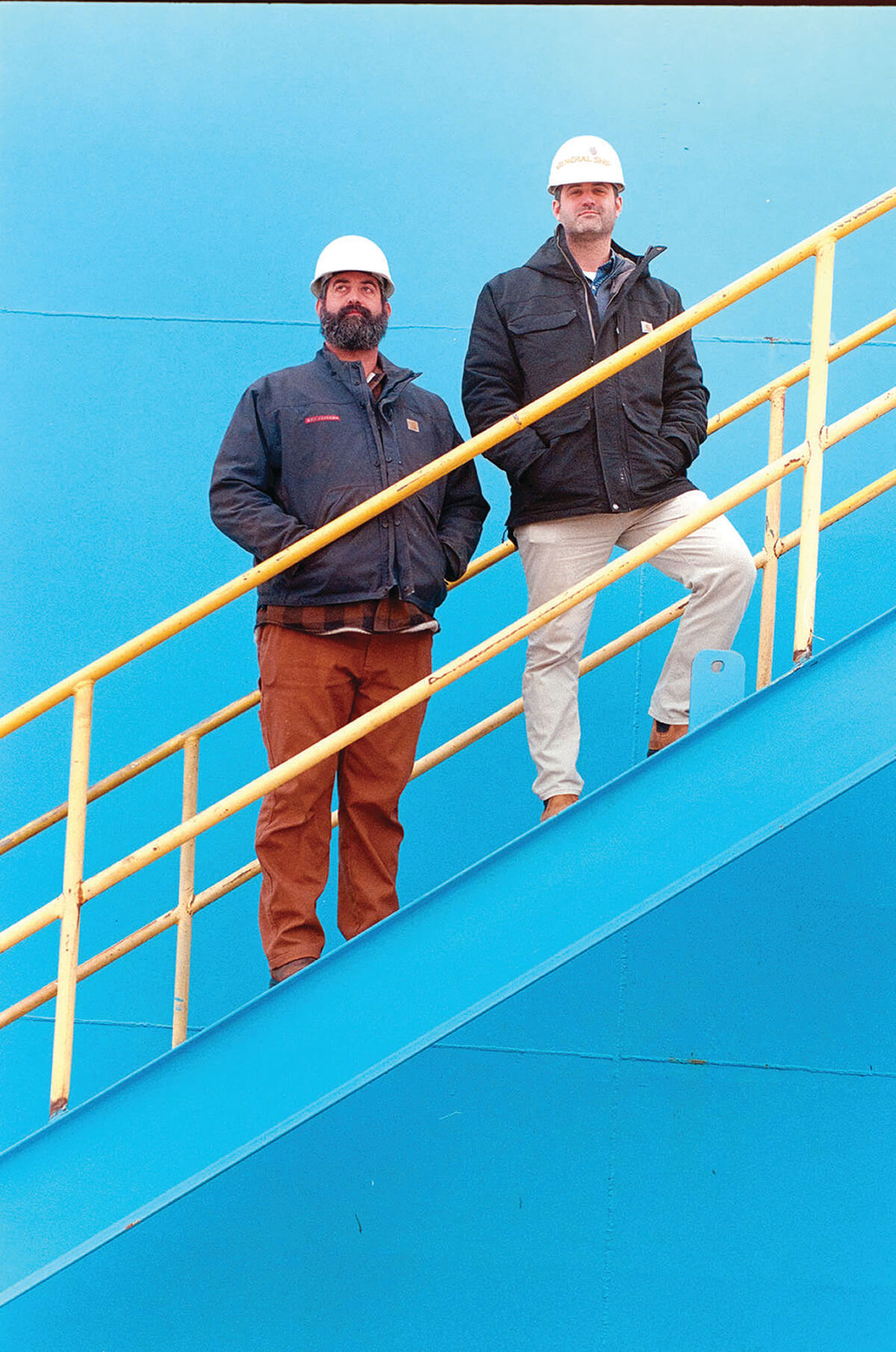
As he sits behind his desk, his father’s desk nearby, three generations of his family looking down from their portraits and photographs, Ryan seems remarkably comfortable, a man happy in the setting he quite literally grew up with. While his brother, the company’s vice president—tall, black-bearded—looks like a waterman, Ryan—youthful, clean-shaven, and clean-cut, with a Carhartt jacket taking the place of the mandatory life jackets worn on the pier—presents more like a weekend-dad outdoorsman.
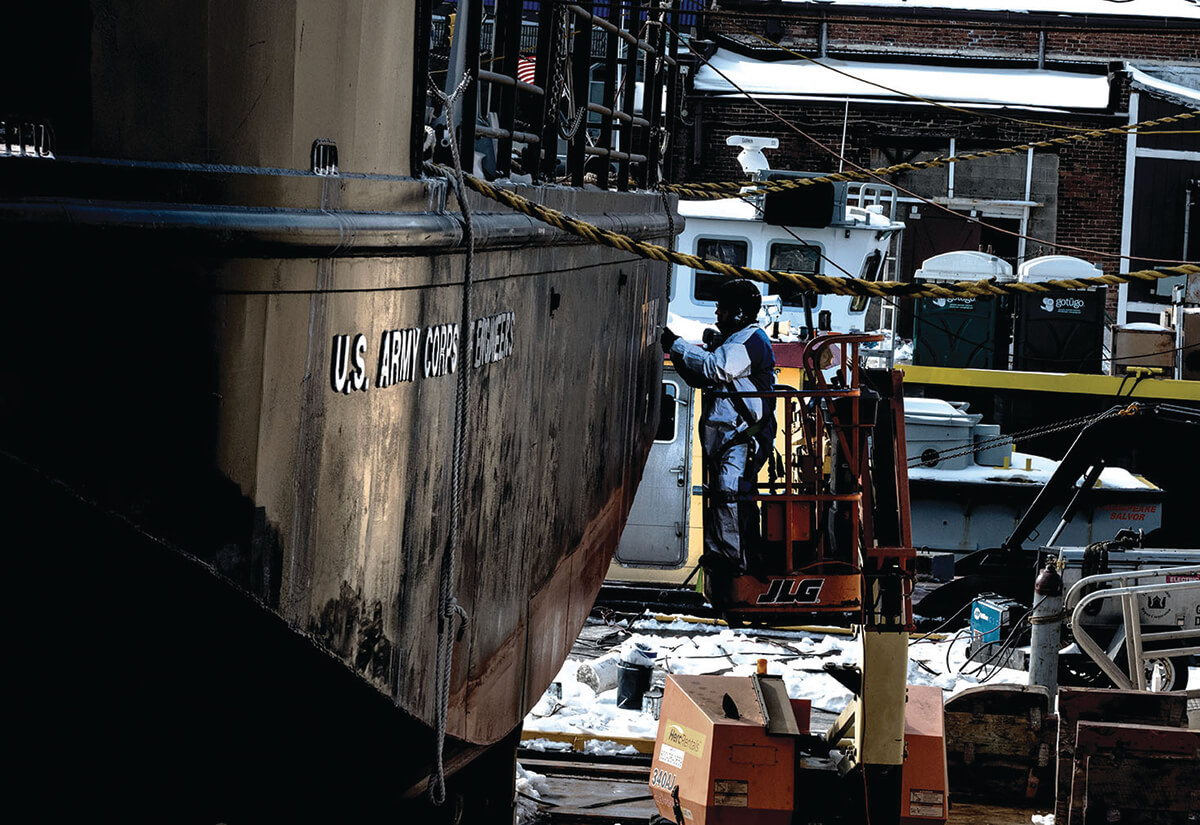
“We’re taking tugboats or dinner-group cruising boats or smaller, 50-to-180-foot vessels and dry-docking them, so lifting them out of the water and being able to do full dry-dock work—blasting paint on the hull, any steel repairs on the hull, any mechanical work that needs to be done underwater,” Ryan says.
GSR also travels to ports to work on big ships like the gray military vessels that anchor nearby, and they’re able to do on-site emergency repairs when and wherever needed (they’ve gone as far afield as Hawaii).
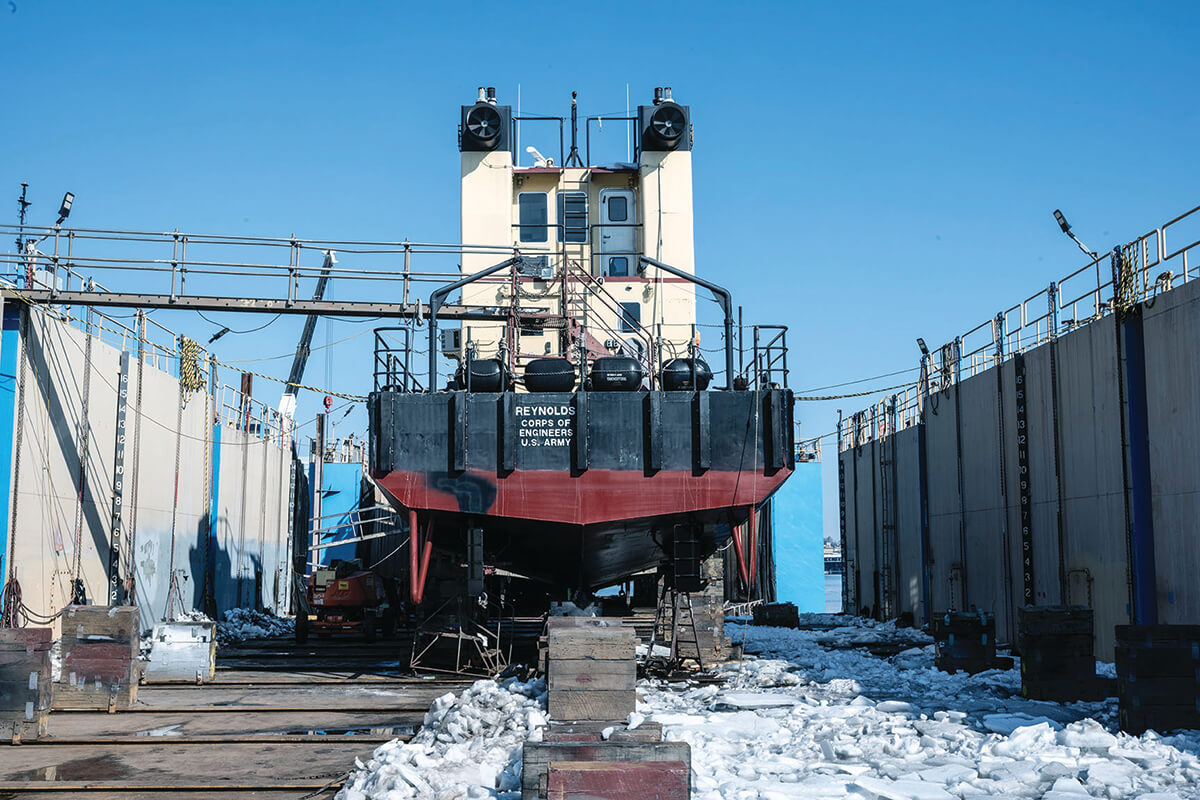
Back in the day, paddle-wheelers—historic steamboats with large, engine-driven, submerged wheels that propelled the vessels—would come into the Inner Harbor and head to the original location of GSR for repair. These days, much of their current work is done at the two massive dry docks at the pier a few hundred feet from where Ryan is sitting. There, at the location that’s been their home for the last century, GSR’s crew can work on two ships at a time, “plus whatever’s in the water.”
Here’s the thing about ship repair: It’s painstaking work, alternating between dangerous jobs and a lot of patience between them. But it’s also highly skilled, time-honored work, and an absolutely critical component of any busy port.
Here’s the thing about ship repair: It’s painstaking labor. But it’s also highly skilled, time-honored work, and an absolutely critical component of any busy port.
Ryan pulls up historical photos of this southern stretch of the Inner Harbor, once a row of dry docks and graving docks—the narrow, excavated basins with reinforced walls used to repair ships too large for dry docks—and machine shops, where now there is only the shipyard his great-grandfather began. Over the years, as each generation took the helm—from Buck to Buck’s son, Jack; to Jack’s sons, Derick, Mike, and Cary; to Derick’s sons, Ryan and Chaz—the business grew.
“The technology of ship repair hasn’t changed too much,” says Ryan. “The machines get nicer and better, but they’re not crazy. It’s not like we’re using robots.”
He gestures over to a second wooden desk in the corner, the one used by his father before he retired in 2023. Derick wanted to keep the desk, though it’s clear it’s mostly honorary—these days, he just comes in for board meetings. But the desk functions like the portraits on the wall, a reminder of a century’s worth of history: of family, of ships, and of Baltimore.
Walk across the bridge—an old metal walkway salvaged from some ship or pier—from Ryan’s office to the newer machine shop, then downstairs and across a parking lot to the pier and its two dry docks, and you can see the Domino’s sign to your right, a neon reminder of the duration and history of Baltimore’s storied Inner Harbor.
Though many Baltimoreans’ experience of its maritime history tends to be limited to trips on the water taxi or a booze cruise excursion or visits to the Frederick Douglass-Isaac Myers Maritime Park Museum, it’s worth noting that Baltimore is the 16th busiest port in the country, in 2024 handling 45.9 million tons of international cargo valued at $62.2 billion. It took the collapse of the Francis Scott Key Bridge in March of 2024 to reify to many of us the importance of Baltimore’s port.
“I think people don’t know too much about the maritime industry and how important it is,” says Ryan, noting that this changed when the bridge fell. “Luckily for us, we had a lot of projects already here, like long-term projects,” when the disaster occurred and blocked the entrance to the harbor for 78 days while crews worked to safely clear the debris.
“This industry is very much a rollercoaster,” he continues, noting the obvious: that a vital aspect of any busy port is not only its access, but keeping the vessels that use it well-maintained. The company has repaired a hundred years-worth of barges, tankers, and tugs, and these days they work on maybe 20 to 30 vessels a year, many of which include boats docked for Coast Guard-mandated maintenance that might take more than a year to complete.
“The technology of ship repair hasn’t changed too much. The machines get nicer and better, but they’re not crazy. It’s not like we’re using robots.”
They’ve also worked on such notable vessels as the Pride of Baltimore II, the historic Baltimore clipper ship reproduction; the WW II restored Liberty ship, the S.S. John W. Brown; a series of Army Corps of Engineers boats; the N/S Savannah, a historic nuclear-powered merchant ship; the icebreaker A.V. Sandusky, which is operated by the Maryland Dept. of Natural Resources and which GSR originally built; and, yes, even Baltimore’s famous trash wheels (while not quite ship-sized, they’re big enough to warrant expert repair).
GSR also has a long-term relationship with the small fleet of the Historic Ships of Baltimore, which includes the USS Constellation and the submarine Torsk, all permanently docked on the northern side of the Inner Harbor. This breadth of skills is reflected in the trajectory of the current generation of the Lynch family. Both Ryan and his brother, Chaz, along with Dave Gross one of two current vice presidents, worked in the shipyard alongside their father and uncles during high school. Ryan graduated from the Merchant Marine Academy as a maritime engineer, then worked on commercial ships; Chaz enlisted in the Coast Guard.
“I joined the Coast Guard to get out away from home, and so I pretty much went as far away as possible,” Chaz says of his stint, which included three years in Alaska. Then, perhaps inevitably, came the pull home. “I wanted to come back to the family business,” Chaz says, now in his office down the hall from his brother’s. “This is what I know.”
Office manager Jessica Morrison, who in 2019 had the daunting task of succeeding a woman who had worked for GSR for 48 years (“hired by my grandfather,” says Ryan), came to the company not from the Coast Guard but from the Baltimore Symphony Orchestra, where she played the French horn (“I went to Peabody for too many degrees to count”). But she is also a longtime sailor and so was attracted to a maritime industry job. And one of the many things she loves about her job is exactly that history.
“It is incredible talking to all these older employees, or people who just worked around the port, and hearing their stories and really thinking about how much of an influence ship-building has had in this area,” she says one morning at her desk down the hallway from Ryan’s office. Her office, too, is decorated like a ship museum, photos and paintings of historic ships on the walls, hard hats and lifejackets strewn across various chairs and tabletops.
“We are the western-most seaport on the East Coast,” Morrison says, underscoring the importance of the port of Baltimore that many don’t realize. “The reason why we get so many of the cars on the railroad ships? It’s the least expensive way to bring them in here, because we are the farthest-west point for them to load them onto rail cars.
“The maritime community is such a transient community,” Morrison continues. “But we have a very high retention rate here. Most of the other yards on the East Coast aren’t like that. If you go down to Virginia Beach, some of the larger yards down there, they’re all contracted, and they move around constantly.”
“I wanted to come back to the family business. This is what I know.”
Her favorite part of the job is seeing the historic ships they work on. (“I always go and nerd out with them whenever they show up.”) And she loves that, until recently, all the records were kept by hand—as in handwritten or typewritten—until Ryan took over and she was tasked with moving the company’s record-keeping process to digital.
But what Morrison is most proud of is GSR’s apprentice program she spearheaded, which is in its third full class. “Maryland public schools have a great youth apprenticeship program. And depending on which school district you’re in, some of them will do more with warehouse or maintenance or automotive—those are the big ones. We were their first maritime program, and it took me years to get all the paperwork through.”
This is at least partly because working in shipyards is one of the most dangerous of professions, only behind working as a stevedore those who unload cargo from ships), and so convincing the state of Maryland that they were going to keep kids safe took some work. The goal is to give students real-world experience that can lead to maritime industry jobs.
“But the other part of this for us is we’re building a pipeline for ourselves,” Morrison says, noting that GSR hired both of their first two apprentices. The experience has been as meaningful for the crew as it has been for the kids. “They take them under their wings,” she says of the longtime GSR employees, “and they’re supportive. It’s been a really great experience, not only for our practices, but for our staff.
“Now I’ve got these high school students, and I have people who are mentors for them, who are peers, who said, ‘I started out here, yeah, and now I’m here, and you can do it too, and I can show you.’ And I think some of our old-timers are really happy to show them the ropes.”
Later that morning, the crew moves a tour boat around the pier, maneuvering the ship into the three-section dry dock. Men in hard hats and lifejackets walk the parapets and shout orders to others moving and securing tow ropes as the huge ship comes around the corner and settles in. The water has already risen, coming in from the Patapsco, flooding over the supports and creating a stable system for the needed repairs. In fact, this is a stable system, of mechanics and history and family, all coming together to continue the long trajectory of this city’s maritime community.
It is a community that is set to continue for this family-run business, as Ryan and Chaz have four kids between them, all under the age of 10. “They’re very young,” says Chaz, “so we’re going to leave that decision up to them.”
But young as they are, they’re all out on the water with their fathers “as much as possible.”
Come what may, the fifth generation of the Lynch family will likely be carrying on their longtime tradition, eventually, on and in service of the water.