News & Community
The Bmore Community Fridge Network Fights Food Insecurity, One Refrigerator at a Time
Given the government shutdown, soaring grocery prices, and federal cuts to food-assistance programs, the need for the grassroots initiative is greater than ever.
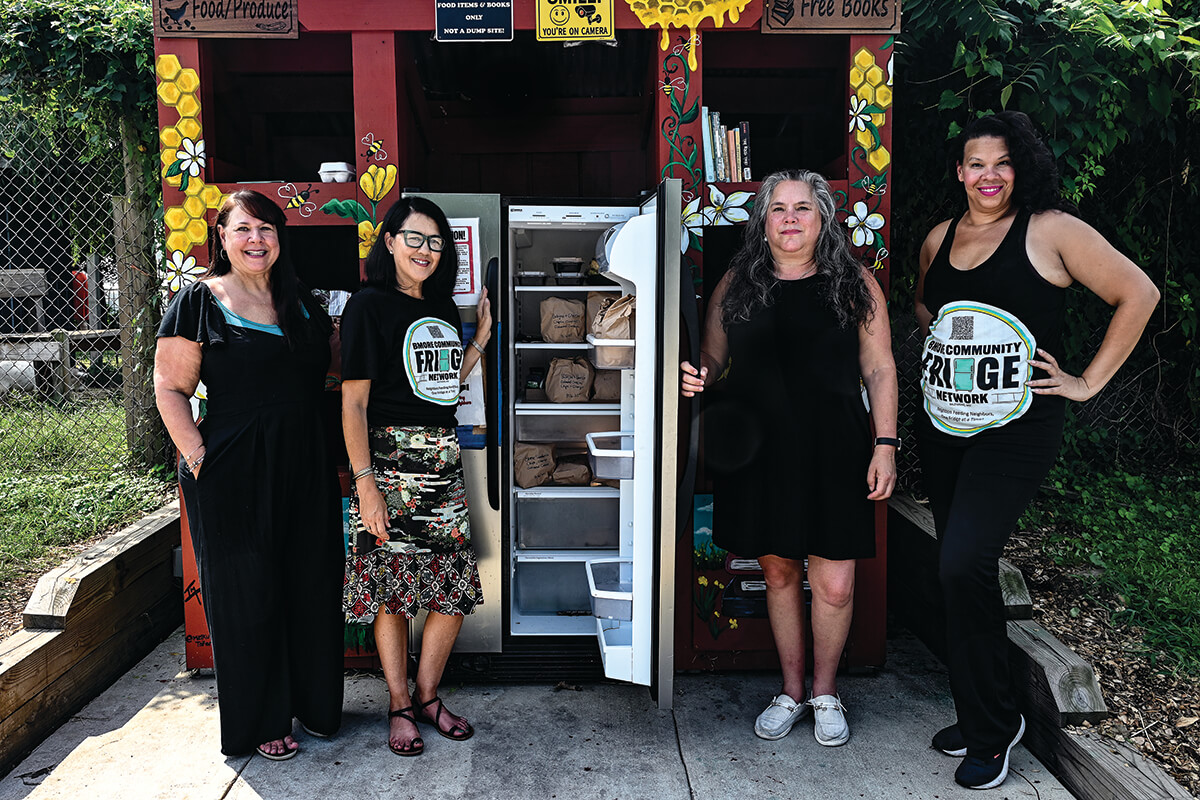
The refrigerators are stationed all over the city. They come in varying sizes, some built into public shelving for canned goods, others standalone, many painted or decorated and looking more like art installations than food banks. They’re often remarkably beautiful, fitting into a Baltimore landscape already enhanced with salt boxes and murals and Little Free Library huts.
Just north of Patterson Park, there’s a mini-fridge, painted turquoise with the face of a cat. In Curtis Bay, another one is built into burgundy shelves stacked with canned goods and books in front of a community garden. In Hamilton, another, tucked inside a white-picket shed the size of a doghouse. And in Station North, next to another community garden, a full-size fridge is adorned with a stunning orange-headed bird, its wings spanning the breadth of the door.
Though the grassroots network started in February, by late summer the Bmore Community Fridge Network (BCFN) had 17 fridges installed around the city, plus 11 food pantries and three pet pantries, with more in the works.
Started by four women to address growing food insecurity around Baltimore, BCFN is not a nonprofit, nor does it rely on city or government funding of any kind. Rather, it was founded by a group of volunteers who coordinate free food, meals, and other resources across the Baltimore area.
Many of them met for the first time at their first community meeting, held the first weekend of August. Canton resident Julie Kichline, who owns Kik-line Design; Liz Miller, a Baltimore County Public Schools art teacher; retired consultant Lila Perilloux, from Anne Arundel County; and Marci Yankelov, a REALTOR® from Bolton Hill, each came to the project for varying reasons, but all share the same goal: to do something about the growing issue of hunger in Baltimore.
Until recently, the fridge network was an ad hoc system that people—both those who needed food and those who supplied it—discovered through word of mouth or accident. Most fridges are donated by either individuals or businesses, set up on someone’s front yard, and filled and refilled when needed. A loaf of bread, homemade soup in Tupperware, takeout Chinese food, a stack of sandwiches.
“That’s not good enough, in our day and age,” Miller says of that haphazard approach.
“I just kept thinking, there are a lot of resources, but it doesn’t seem like they’re connected,” says Yankelov, a longtime food pantry volunteer who co-founded the Baltimore Supper Club, a cooking group with thousands of members.
She was increasingly frustrated by food waste and disorganization. People wanting food would ask her to deliver a pizza or call her up at one in the morning to see if she could bring dinner. Meanwhile, food insecurity was growing, people were being laid off in droves, and funding was being cut.
So the BCFN was born, given a name and a home on Facebook, where volunteers post messages and news, as well as a map of locations, links to donation and sponsorship forms, and other helpful information. It’s still a grassroots network, a system of community organizers and volunteers, and it receives no funding but relies on generosity and donations—of food and resources, of the refrigerators themselves, and of time and spirit.
And the need is greater than ever. A 2024 Johns Hopkins study found that 28 percent of Baltimore-area residents reported experiencing food insecurity, defined as not having consistent access to quality food on any given day. Only 15 percent of those experiencing food insecurity are also unhoused, and, according to the Maryland Food Bank, nearly 39 percent of food-insecure Marylanders have too high an income to qualify for government assistance.
Recently, the issue has gotten even more acute, given soaring grocery prices and federal cuts to food-assistance programs. A 2023 USDA study put the number of food-insecure households that have children at more than 82 percent.
A 2024 JOHNS HOPKINS STUDY FOUND THAT 28 PERCENT OF BALTIMORE-AREA RESIDENTS REPORTED EXPERIENCING FOOD INSECURITY.
Community fridges gained popularity during the COVID pandemic, when grocery shelves emptied, food insecurity rates rose, and many people found themselves either out of work, stuck at home, or both. Many cities, from New York to Chicago, began fridge networks. Both Miller and Perilloux point to New Orleans—where Perilloux has lived and volunteered—as a successful model.
How many community fridges or community fridge networks exist isn’t clear, although the database Freedge, which tracks them and offers support and even templates for building a “fridge hut,” lists close to 400 in the U.S. with more worldwide. (The UK, which also has a food system in crisis, has an estimated 700 community fridges.)
A fridge hut is a necessary component, a way not only to protect the appliance itself but to buttress it, often literally, with shelves or cabinets for other items like canned goods, books, even pet supplies. In Hamilton, one volunteer built a housing unit, of sorts, to store the fridge. Miller arranged for a donated refrigerator, dropped it off, “And everybody in the neighborhood was like, ‘Is this a rabbit hutch?’”
The BCFN Facebook page reads like the local grassroots organization it is. “Major discounts on meat this morning at Safeway and I’ve been cooking all day!!” one volunteer posts. “If anyone is inspired to cook a bunch of eggplants, I’d be happy to get them to you tomorrow or this weekend. I also have some summer squash, basil, cucumbers, and jalapeños,” posts another. “I spent a few hours with some of the Youth Works young people re-portioning large trays of rescued Chinese food into containers. We have 30+ meals,” Yankelov writes. “Help! I’m at the rec center at Bentalou and Baker Sts. Which fridges should I drop to? These are like bagged lunches…a lot of them,” another voice chimes in.
It’s an informal web of generosity, commitment, effort, and time, with volunteers working together to stock the fridges and pantries across the city when and however they can. Various businesses and organizations donate some of the food; volunteers buy ingredients on sale or harvest produce from their own or community gardens. One day it might be a few hundred bagels, another a weekly donation from Panera. Still another, a box of pastries, a sale at Aldi, an Amazon ingredient wish list that translated into a box of homemade sandwiches.
Volunteers source containers and shelf-stable items, post messages to coordinate efforts, and regularly monitor the fridges. Someone cleans out wilted vegetables; another makes sure that bags of donated baked items are distributed among many fridges rather than dropped off at one.
“We’re encouraging people to label foods, to date the foods, to note if there are any allergens,” says Perilloux, who adds that she’s been adding vegetarian meals to her repertoire since she realized the need for them.
“The demographics of the fridges are all different,” she explains, noting that they’ll leave flatware at some sites for those without kitchens.
“We’re not responsible for starting from the ground up,” says Miller, “but we do house the map, and anytime we learn of a fridge or a pantry, we add it to the map.”
Some of the fridges were already extant, either set up by someone with an extra unit on their property, as part of a pre-existing organization—as with the Govans fridge, set up by a partnership between Loyola University and Calming Leaf Foundation—or moved by BCFN from another site. There’s also signage now, as well as QR codes that link the sites so that those who need food and those who want to help can connect.
“You can find the other locations, and you can learn that it’s just part of a larger movement,” says Miller. “You’re not alone.”
Dallas Fitzsimmons, an auto mechanic who’s lived in Poplar Grove for the last four years, still visits the fridge on Ashburton Street. After a catastrophic car accident, he was hospitalized for two years and lost everything he owned.
“Nothing but the clothes on my back and some wrenches and a suitcase,” he says. “When I moved in here, I ate out of that refrigerator about three days a week.”
Now back on his feet, Fitzsimmons has restarted his business and gives back to the community. “It brings me to tears,” he says now. “That refrigerator kept me from starving.”
The BCFN hopes to organize a system without giving up its grassroots community to help those in need. They don’t have a website; they’ve resisted becoming a nonprofit.
“We do everything without money,” says Miller, who admits she doesn’t know how much food makes its way through the system. But she prefers it that way. BCFN functions more like a barter system than an organization with paid employees, record keeping—and bureaucratic red tape.
“We had a guy, he lost his house, and he was like, ‘I have a full-size freezer and a full-size fridge, and it’s full of food, and we gotta be out in three days. So anybody who wants to come by, DM me.’”
Not only did the food get used, but volunteers came together to help him find a truck, a storage unit. “People were coming through for him. And at the same time, he’s busy coming through for others.”
As BCFN co-founder Kichline puts it: “Sometimes we help, sometimes we need help, and sometimes it’s both.”
“SOMETIMES WE HELP, SOMETIMES WE NEED HELP, AND SOMETIMES IT’S BOTH.”
In the back of Red Emma’s, the Waverly worker-cooperative bookstore and cafe, past rows of tables with folks on laptops with oat-milk lattes and tempeh BLTs, a large white fridge sits next to loaded bookshelves and a rack of clothes, all free for anyone who needs them, as are the contents of the refrigerator.
It’s a Waverly Community Fridge that started in January, a month before the BCFN was formed, and isn’t run by Red Emma’s so much as overseen by the bookstore and cafe staff.
“It’s here, it’s part of the network insofar as it helps people get access and know where they are,” says Red Emma’s Taylor Morgan. “The handy thing about having a restaurant and not wanting to have food waste is that whenever we have leftover food, we can package it up and put it in the fridge.”
As Red Emma’s already had a resource center for food, clothing, and hygiene and health supplies, it made sense to put the community fridge inside there, too. It was also, well, inside.
“Outside is difficult because it’s harder to monitor the cleanliness of it. The elements affect the fridge,” says Morgan.
There can also be issues with property ownership and electricity bills. Another plus with Red Emma’s is that it already functions as a community center, so it’s easy for folks to walk past the brick walls and Edison-bulb lighting and either drop food off or collect it.
“There’s no stipulations on who can put the stuff in the fridge and who can take the stuff out,” says Morgan. “And that’s our concept around mutual aid.”
On any given day, Red Emma’s might package up soup or chili or pastries that haven’t sold by closing time. If there’s a catered event at the restaurant, leftover platters might be donated. Other restaurants also have the option of bringing by leftover food, knowing that Red Emma’s can handle the items.
“There is such a demand,” Morgan says. “People of all ages—people with kids, elderly people—come here every day. We have regulars.”
“Food tends to not sit in any of the refrigerators. I mean, we can’t keep them filled,” says Perilloux. “I put 23 meals in a fridge yesterday morning, and they were gone in less than 30 minutes. I feel like, you know, we can’t do enough. We just cannot keep these fridges stocked. I went to the Govans fridge once, and there was a mom just sitting on the curb with her two kids, and she said, ‘Oh, I was wondering if somebody was going to come today.’”
“Everybody comes, the community, the church, so many people come,” says Val Clark, of the Filbert Street fridge in Curtis Bay. “I’ve been putting in, taking out, putting in, taking out. I probably do more putting in than taking out,” says Clark, a New Orleans native who moved to Baltimore in the wake of Hurricane Katrina and lives across the street from the Filbert Street site, which includes not only a community garden but an apiary and both chickens and goats.
“WHEN I MOVED IN HERE, I ATE OUT OF THAT REFRIGERATOR ABOUT THREE DAYS A WEEK.”
Jim Metz, a Fallston retiree, got involved with the BCFN after doing work for decades with both animal rescue and food donation. Between the shopping, making sandwiches and meals at home, and dropping off food, he spends about 30 hours a week volunteering.
“I saw [Perilloux’s Facebook] post and I thought, ‘Here’s something that I can do,’” he says. “My wife has been a social worker in the city forever, and I hear her stories about all the stuff that’s happening now, so I do whatever I can.”
Metz goes to various sites throughout the city, sometimes stopping at a few on each trip. “The fridge I go to first is empty, and I’ll fill it, and keep track on Facebook,” he says.
Metz juggles occasional donations but mostly pays for everything himself, combining grocery-store sale items plus vegetables and eggs he might get from friends with gardens and chickens. “And sometimes, you know, I barely get back into the car and fix my pictures to post, and there’s a couple people walking [to the fridge] from different directions. So yeah, we’re trying to help where we can.”
The BCFN volunteers wear many hats (metaphorical hats, often sun hats), as they coordinate food distribution through a web of partnerships, from private citizens to businesses to food banks.
“We’re not a nonprofit and I don’t know that we’ll ever be,” says Perilloux, who also moderates the Facebook group Feeding Baltimore, “but a lot of our donations get funneled through Leftover Love to the fridges.”
Omar Tarabishi co-founded the nonprofit Leftover Love at the beginning of 2024 to rescue leftover food from local businesses, working to collect donations and transport them to those in need. To date, the organization has rescued more than 98,000 pounds of food. But while this works well with larger donations, it becomes problematic with smaller ones.
So Tarabishi began filling the Linwood Community Fridge, which is near his Highlandtown home. “It’s been really great, because sometimes we get more of those smaller donations, and it doesn’t make sense for us to drop off at a large institution like Helping Up Mission or Charm City Care Connection or The Baltimore Station for veterans. Bringing a small bag of Jamaican patties to feed 500 men doesn’t make sense, right? So we would donate to a lot of these community fridges.”
Tarabishi, in turn, spread the word of the community fridges to his larger network. “We’ve put some of our donors and volunteers in touch with these closer fridges, to stock Ashburn, to stock Reisterstown, to stock Curtis Bay, as well as others all over Baltimore.”
He gives a lot of credit to the volunteers at BCFN for linking up the system. “People come to us because they’ve heard of BCFN, and they want to rescue the food to put in other BCFN fridges. We’re addressing food insecurity and food waste in Baltimore together, as well as just connecting neighbors.
“They can operate in the gray spaces or in the loopholes,” Tarabishi says of the grassroots network’s ability to maneuver outside the restrictions of larger operations that are tied to strict regulations. “They kind of saved us.”
Fridge by fridge, they’re saving a lot of us.